
At an age where historically boys would be sweeping chimneys or being used as cannon fodder, instead I spent the first half of my childhood in the 1980s living a Totally 80’s™ lifestyle in the best way possible: with tons of toys and tons of television.
Not that my parents plopped me in front of the TV and forgot about me like so many Garfield paperbacks but they saw that I liked it and there was nothing too harmful airing in those days. And even if there was, I just wanted to watch cartoons anyway.
Even though in present-future there are networks that literally play children’s programming 24/7 and entire channels devoted to cartoons and in fact you can just recall almost anything in history instantaneous on your refrigerator, back in the 1980s you really had to plan to catch your favorite toons on TV. Either you caught syndicated cartoons in the weekday afternoons after school or waited for the bonanza that was Saturday Morning Cartoons.
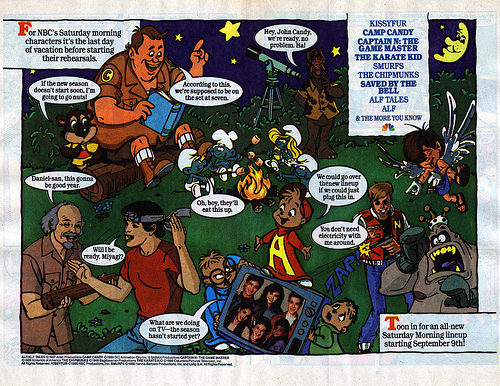
Outside of that, there’d be a few funky offerings on Sunday morning (usually of the religious bent or low-budget Hanna-Barbara fare from the 70s) and, if you got up really early before school, they’d run old Three Stooges shorts along with some classic Looney Tunes (at least that was the schedule in my market).
But you had to watch it live whenever anything was on, and until VHS tapes came down in price in the 1990s it wasn’t economically feasible to try and tape your cartoons to view at your convenience, as each blank VHS cost approximately the same as a space shuttle mission. Besides that, you were just a kid with no money anyway and it’s the 1980s so pipe down.
And something else happened in the 1980s, something both wonderful and horrible: during the early 1980s, children’s television deregulation—especially the FCC’s 1984 relaxation of its policy on program-length commercials—helped change what the nature of programming intended for a child audience could be. Mainly, they swept aside all that stupid educational programming like Schoolhouse Rock and instead replaced it with money-making half-hour commercials for toys like G.I. Joe, He-Man and the Masters of the Universe, and My Little Pony. Nothing could have fit in with the times better than kids’ cartoons that existed solely to sell them stuff.
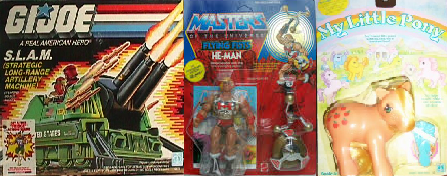
And boy, did it work: I remember amazing Christmas mornings where all my dreams came true as “Santa” brought me stacks and stacks of toys from my favorite cartoon shows. In one banner year, I got the Ecto-1, a bunch of Ghostbusters figures (Ray and Peter, of course, along with Stay Puft) and a plethora of He-Man figures. Another year I think my parents just bought me every single Teenage Mutant Ninja Turtles figure and accessory they could find. It was glorious. It was materialistic as hell, but it was glorious and I was happy.
But cartoons weren’t just about selling the toys: they were also about expressly selling a whole bunch of other garbage to kids! Other toys would advertise on the commercial breaks, along with cereals, snacks, ephemeral knick-knacks like snap bracelets, and a whole bunch of other crazy crap that was being mass-produced for kids to throw fits over until their parents bought it for them. Yes, the 1980s were a magical time where kids became targets for market research and direct sales and learned how to become good little consumers.
The ’90s only made the whole operation more ridiculous: computer-generated heroes, cartoon comedians, actual good superhero adaptations and feature films that seemingly had no business becoming children’s television. Somewhere along the way I began collecting memories of these shows the way I used to collect the toys. Here they all are—some classics, some crap, and more than a few that probably had no business existing.
How to read this monster: There’s a handy index of all 70 cartoons just below if you want to hop straight to a favorite. Or, if you’d rather take the whole nostalgic trip in order, start reading at the beginning with the 1980s.
1980s: The After-School Syndication Empire
The weekday-afternoon cartoon boom, where toy shelves and television schedules became inseparable.
He-Man and the Masters of the Universe

It’s no understatement in saying that He-Man and the Masters of the Universe had a huge influence on little boys across America in the 1980s. But why? Probably because he was just some doofus most of the time with a cowardly pet, but just by pulling out a sword and screaming, “I HAVE THE POWEEEER!” lightning shot all over the damn place and he became He-Man, muscly dude who was there to chew bubblegum and kick ass, and he’s all out of bubble-gum. Oh, and his cowardly talking(?) big cat turned into a ferocious armored warrior tiger.
But there was a lot of other cool stuff that appealed to little boys. He had his own posse that was in on his secret that would have his back, and his enemies were a bunch of crazy creatures that he beat every time, and they lived in a demented medieval world that also had futuristic weapons and flying vehicles.
And the art style was similarly awesome, to the point where contemporary artists emulate it to capture its nostalgia and vintage appeal. The show pretty much holds up–I mean, it’s simple, but for nostalgic purposes it really hits the spot. Sometimes I’ll throw on an episode with the sound off and just have it running in the background for atmosphere and because I enjoy the visuals so much. For the 80s, it was pretty darn rad indeed.
G.I. Joe: A Real American Hero
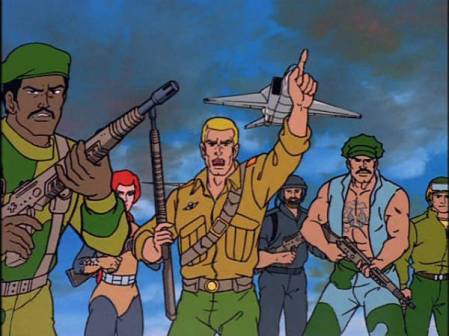
I’m tackling the “big three” of mid-80s cartoons little boys watched because they’re some of the era’s most recognizable properties. What to say about G.I. Joe: A Real American Hero? Great classic animation, the recognizable hallmarks of its formula (including never actually killing the enemy [unless they’re cyborgs], reused animation cycles, and a lot of action sequences that don’t really affect a permanent solution), and its animation style are synonymous with 80s cartoons.
It wasn’t my favorite show but I watched it pretty much every day as a little kid. I think in my local market it came on after He-Man. I have lots of memories of having G.I. Joe playing in the background while playing with my toys. Switch this around a little with YouTube videos playing in the background while I write and I’m pretty much in the same situation today. It’s a fun, classic cartoon that you can throw on for a little nostalgic blast from the past. Yo, Joe!
The Transformers
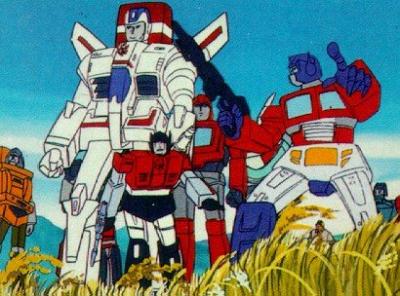
Completing the Holy Trilogy of 80’s cartoons for boys, The Transformers is literally a show about vehicles that turn into giant robots who then fight other giant robots. Of course it was a big hit with little boys when it aired. And of course it’s still a big hit with little boys and adult boys today. I mean, did you read the part where giant robots fight other giant robots? And they turn into cars?? Whatever marketing genius came up with this idea hopefully still gets a percentage of the billions this concept still generates.
The original cartoon is still rather enjoyable, but it’s so difficult at this point to understand whether it’s because I have such strong associations with it and my own childhood or because the show itself is pretty good. The animation kicks ass, so I’ll give it that. I’m a real sucker for the 80s animation style in these syndicated shows from this time period so I just like watching it. The transforming sound is also super-cool still; I wonder if any DJs have sampled it. Is there a subgenre of music that incorporates sounds and music cues from old 80’s cartoon shows? Because if there is, I’d really like to hear it. Anyway, The Transformers is a true classic from this totally rad decade.
Jem
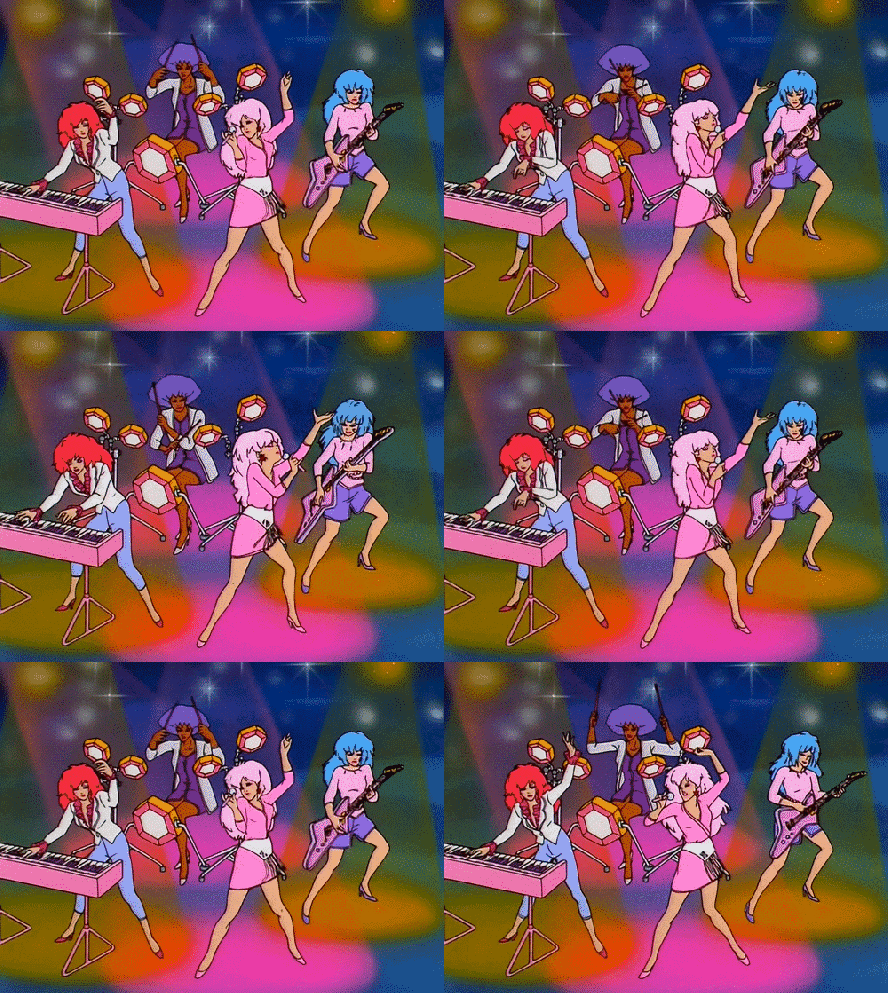
Whooa Jem (Jem!) is truly outrageous, truly truly truly outrageous. This show is truly outrageous, as well: music company owner Jerrica Benton finds a supercomputer her late father built that can turn her into totally rad music superstar Jem. While taking care of her foster home, Jerrica/Jem also gets into high-fashion adventures with her band and uncovering various schemes to find out now-superstar Jem’s secret identity, among other things.
Jem and The Holograms tour the world and fund the foster home while Jerrica handles the business off-stage, which must be exhausting. Meanwhile, The Misfits–the “bad girl” group that’s always scheming against The Holograms–are there to make trouble and mess up everyone’s well-laid plans.
Like many of these cartoons, Jem was initially created to sell toys but wasn’t a very big hit during its initial three-year run. But it is a memorable kids’ show centered around female protagonists who are doing admittedly cool things most of the time. It’s since become a cult hit among my generation and holds up as a rather slick show with an astounding number of original songs (averaging something like two an episode) for a kids’ show–or any show, really. It’s also insanely 80’s in its style and sound and is one of the most distinctive animated shows reflecting the era.
Inspector Gadget
I was surprised to find out that Inspector Gadget was a first-run syndicated show, but then again I didn’t know what that was when I was a kid–I just knew that this show was on TV and I watched it. One of the more formulaic shows in a decade of unbelievably formulaic shows, and a show that I watched often but had no special fondness for, it’s a fodder show.
Why is it here? Because it was a ubiquitous show in my childhood and obviously a wildly successful syndicated show since it was on like 5 times a day on various channels when I was a kid. Or maybe it just seemed that way and a channel was just running it that often. Anyway.
The setup is simple: Inspector Gadget is a clumsy Clouseau-esque detective that has a ton of crazy gadgets and mechanics built inside of him. This involves a lot of hammerspace physics where somehow both a helicopter and umbrella can spring out of the top of his head, both roller skates and trigger-loaded foot springs that shoot out of his feet, a phone that comes out of his hand, and cuffs that come out of his forearms. I guess there wasn’t much room for his brain since he’s a walking disaster and overall idiot.
Fortunately, he has a smart niece with what looks like a tablet (a good 30 years before the actual invention of such a thing) to do the actual detective work and research and her dog Brain. Then there’s Dr. Claw, whom we never see but has a metal hand and is pretty metal himself. The theme song is wildly catchy but the show itself is pretty basic. If I could enjoy it at my age I’d throw it on for nostalgia purposes but it’s not really my speed anymore. It’s a fun show for kids but the gag wears thin–even my feeble child Spidey senses grew weary of the show back then.
Heathcliff and the Catillac Cats
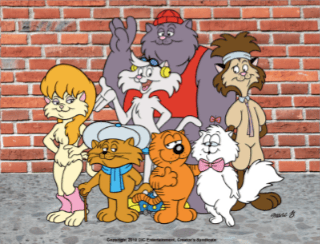
Goddammit, Heathcliff. I hated this show when I was a kid. Did this stop me from watching it? No it did not. But it didn’t mean I had to like it. And I didn’t: Heathcliff’s a jerk and I wasn’t sure what the appeal was supposed to be–a wisecracking cat who thinks he’s the king of the castle when he’s just a damn tabby cat? Yeah, that area was already covered by Garfield. Seriously, what was the appeal of this show? Even the animation was sub-par.
Oh, and there were the Catillac Cats, who were part of this equation but I remember even less about them than I even do Heathcliff at this point. An unpleasant show filled with unpleasant characters, somebody must have thought either this was going to be a great success or else this show was literally so cheap to produce that when sold into syndication it couldn’t help but be profitable. Anyway, not good stuff. Avoid at all costs.
ThunderCats
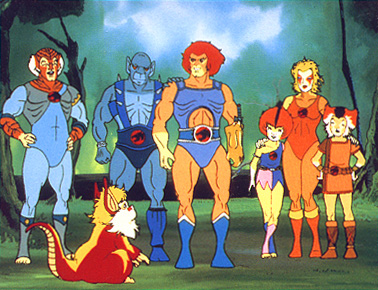
Here’s yet another kick-ass show: The ThunderCats was a relatively awesome show, produced in Japan and voice-acted in the USA (USA! USA!). Following the adventures of a bunch of catlike humanoids from the planet Thundera who have to flee due to the planet dying, and then resettle on Third Earth. There, they become friends with the natives of this planet who help the ThunderCats fight against the Mutants.
With top-notch animation highlighted by excellent action sequences, it’s probably the first show many kids in America saw that had elements of Japanese anime. ThunderCats was a really enjoyable action-adventure show with cool characters and a memorable blend of sci-fi and fantasy. With solid storylines and a smarter-than-average tone that most childrens’ shows didn’t have at the time, ThunderCats was a big hit and still well-regarded today. For fans of classic animation that aren’t familiar with this series, check out some Thunder, Thunder, ThunderCats!
The Care Bears
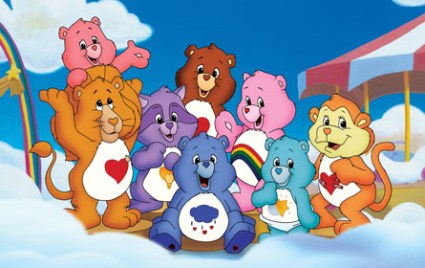
There was something wonderfully tranquil about The Care Bears. It acted like a heavy sedative for young viewers, as the series never got too heavy and it was about cuddly-cute animals that live in Heaven or something that fight hate with love by shooting lasers out of their chests. Someone must have written it after taking some pills.
My childhood home had a lot of Care Bear stuffed animals (two sisters, folks), as the main purpose of the cartoon was to sell truckloads of them. I now remember them as a rather pleasant thing that can take me away from this awful, rotten future we’re stuck in. If I ever lose my mind in some significant way and am put on Thorazine, I think I’ll have The Care Bears playing on a constant loop. Not much to say but sunshine and lollipops all around. And maybe a touch of morphine.
Teenage Mutant Ninja Turtles
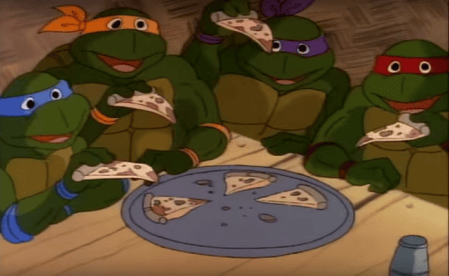
Holy smokes, did I watch a lot of Teenage Mutant Ninja Turtles. In my market, it aired at 6:30 AM so I woke up every day that early to watch an episode. Every. Day. And I couldn’t have been happier: this show was, for me, the epitome of the fun madness that kids cartoons in the 80s had to offer: an off-the-wall premise that somehow worked, likable protagonists, and lots of creative animation and villains, Teenage Mutant Ninja Turtles was a big hit with kids for a reason.
For those that are somehow not aware of this show or its characters from either the original series, the original movies, the rebooted animated series, or the new reboot movies, Teenage Mutant Ninja Turtles is exactly what it sounds like, as these four heroes in a half-shell (turtle power!) and their mentor, a giant rat named Splinter, fight against the villain Shredder, his boss from another dimension Kraang, and their horde of cyborg ninjas (that they can kick the heads off of and that’s fine because they’re cyborgs).
Is it nuts? Sure. Did it get crazier as it went along? Of course it did. Did I love it more than parts of my religious faith and most experiences in actual life as a child? You betcha! As stated elsewhere, the Ninja Turtles were great reflections of the materialist, consumer-driven kids market of the 80’s and damned if I didn’t enjoy every darn shred of turtle merch I could collect. There were hundreds of pieces of turtle-related ephemera and it was just the best. Oh, and the show was pretty fun, too.
Still, maybe I enjoyed the toys more than I did the show: all I know is I wouldn’t watch an episode at my age but if I got my hands on some of the action figures, I’d be the happiest, most demented adult you’ve ever done seen.
Denver, the Last Dinosaur
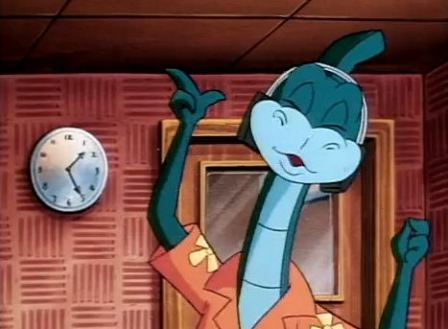
♫ DENVER! THE LAST DINOSAUR! HE’S MY FRIEND AND A WHOLE LOT MORE!♬
I love this show. I love, love, love this show. I made sure I caught every episode I could and don’t think any cartoon ever captured the brainlessly positive and totally radical tone of the 1980s than Denver, the Last Dinosaur.
This show gets a lot of guff but I will never understand why. Maybe because it’s so stupid that people who want to look back on their childhood want to think the shows that were produced for them actually had substance. But really, very few of them did. Maybe that’s why I liked it and still like it: the show is totally stupid and knows it and doesn’t really care.
Or maybe because it hits an idiot portion of my own brain that I wish I could plop an episode into my mind to blank out on actual thinking and just hang out with a radical dinosaur in Southern California in the late 80s. Maybe that’s an ideal temperature (and temperament) I could keep in my mind. Or maybe I just wish I could be a totally rude dude with attitude from the late 80s and that’s where my sensibilities of “cool” truly lay–after all, I seem to have taken my ideal of what “cool” is from the character of Chris Knight in Real Genius and never really developed further from there.
I don’t care: Denver, the Last Dinosaur is still the best. It’s 80’s brainlessness distilled into one cartoon show.
1980s: Saturday-Morning Originals
The Saturday-morning inventions, mascots and strange experiments that didn’t need a feature film to get started.
Snorks
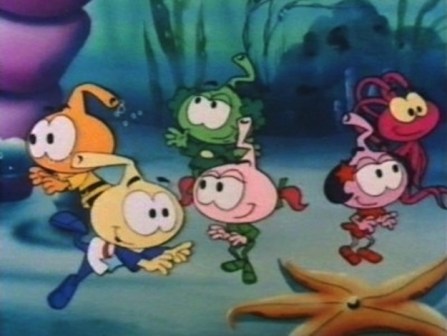
OK: what the fuck were Snorks supposed to be, and was there any reason for this show? It was another one of those “I’m a kid so I like to imagine how cool life as a teenager is going to be” shows, but it’s just damn weird.
Well, they were supposed to be a kind of spin-off from The Smurfs (which I won’t cover in this article because we’ve all had just about enough of The Smurfs by now, haven’t we?), only they’re underwater, have snorkels on their heads that propel them through water, and live in a world much like our own. Besides that, who gives a shit? Well, this property’s parent company did and they spent 5 years trying to make a success out of this like The Smurfs was, to no avail. I guess it’s fun and nostalgic but honestly, if I catch myself watching an episode of Snorks at my age it might just be time to hang myself by snorkel.
Camp Candy
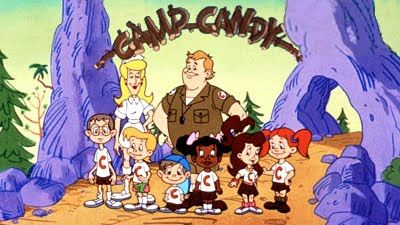
Talk about bizarre: what prompted the existence of Camp Candy? I love John Candy, and he was a genuinely hilarious and likable guy, but where did this come from? Wouldn’t the most appropriate adaptation for a cartoon be him starring as Uncle Buck? Apparently not: apparently, him being a camp counselor was the natural direction.
Camp Candy has one of those obnoxiously catchy theme songs that still rattles around in my head. It’s like They Might Be Giants collaborated on a song with Tom Waits and got John Candy to sing it–who, from the sound of it, didn’t really understand what double-tracking your vocals entails.
Anyway, it’s John Candy as a big goofball camp counselor trying to keep a lid on the wacky shenanigans going on at a camp he runs. And that’s pretty much it. It began to air in 1989 and I was shocked to learn it ran for three seasons–but it makes more sense when you realize that was comprised of only 40 episodes over those three seasons. And 27 of them ran on Saturday mornings on NBC between 1989-1990 with the last 13 created for syndication. So.
I scarcely remember anything about this show but that it was goofy and featured rather shoddy animation and the kid characters were annoying. But John Candy was always a likable sort, just like he was in the movies. But still: what prompted this series? I am genuinely curious. And yes, I watched every single episode as a kid.
Captain N: The Game Master
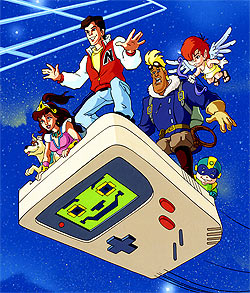
Oof, this show. Look, I didn’t have an NES until I was 10 so a lot of 80s Nintendo culture passed me by and thus made me not interested in anything involving it. I was more of a Captain Power and the Soldiers of Fortune kid. But this show was on and in lieu of actually being able to play Nintendo, I watched this show–which even then I didn’t like because it was very stupid, even to my feeble mind.
It may hold some charm for people that were into it, but there’s not a lot of meat on this bone. Some standard 80’s Teenage Kid was transported into Nintendo-land or whatever, where he went on adventures with Princess Zelda, Mega-Man, and Icarus. It was obnoxious. I didn’t like it as a child and do not recommend for any purpose, nostalgic or otherwise.
Pound Puppies
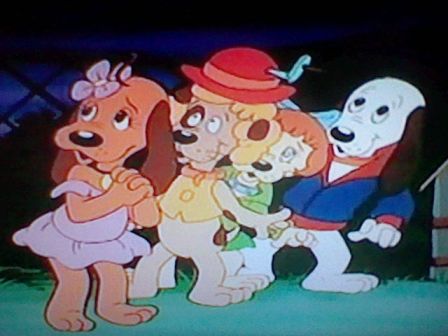
Pound Puppies was one of those shows I watched because my sister liked the Pound Puppies and had a bunch of them but it was frankly a little too young for me even when it aired, and I was only 4 at the time.
It also kind of bummed me out most of the time: these poor puppies just wanted to be adopted, and they were all on their own, and it made my tiny heart sad. The theme song is appropriately memorable but it’s just too aimed at little kids to enjoy as an adult–and this is the guy who a few paragraphs ago whole-heartedly admitted how much he still loves Muppet Babies in his late-30’s. Maybe I’d put this on for my baby–but even she’s a little too savvy for this material.
C.O.P.S.
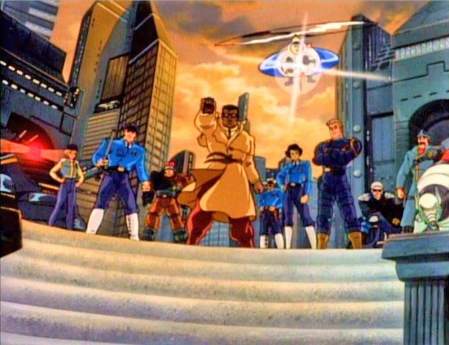
C.O.P.S. was actually a syndicated show first that later aired on CBS Saturday Morning. I was way too young to remember it on syndication but certainly remember it from Saturday mornings. It was…not popular in my house.
As is unavoidable when writing about things from your childhood, some biographical information slips in: I grew up with two sisters, a twin and one slightly older, and neither of them liked the more boy-oriented stuff that I liked. They outvoted me along gender lines so I usually didn’t win on what we watched.
And C.O.P.S. is one of the most boy-oriented shows maybe ever created: it was macho, tons of guns, lots of action sequences, and a mostly male cast of (what else?) police officers. Only they lived in a cool cyberpunk future with cybernetic augmentation of humans, wildly violent weapons, and awesome graphics. Needless to say, my sisters hated it, but I relished the chance when they were distracted by…I don’t know, their My Little Ponies?
And honestly, it’s one of those Saturday morning cartoons that I’d probably enjoy a lot as an adult: it would never be aired today because it was crazy violent and probably a little too adult for little kids, but that was one of the charms of the 80’s–apparently nothing was off-limits for the young. Check it out and see for yourself. It’s pure 80’s craziness and actually pretty damn good.
1980s: Movies, TV and Famous Faces Reimagined
The era when a familiar face, a film title or a successful television character could become an animated franchise.
Punky Brewster
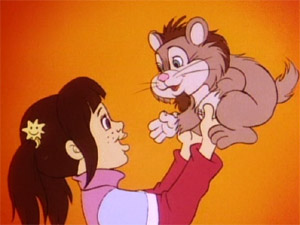
Although the original live-action TV show is well-remembered by people of my generation (even if that one scary episode traumatized a lot of us), Punky Brewster was the continuing adventures of the little girl that turns our world around. The theme song to the cartoon wasn’t as memorable, but the last 10 seconds of it have been playing on a loop in my head for the past 28 years, so that’s something.
It’s kind of like the original series, except in this one she has a magical friend named Glomer that she met at the end of a rainbow who’s been stranded on Earth/our plane of existence/it’s never really specified. Still, it being a familiar thing and me being a little kid, I watched every episode on Saturday mornings. Punky Power?
ALF
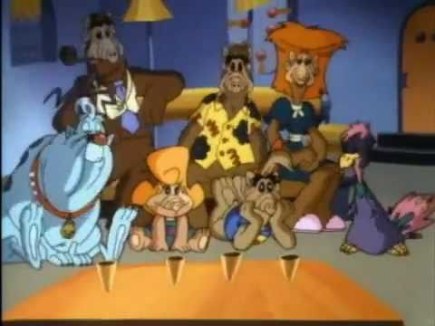
Stretching the boundaries of a live-action TV show when it was translated to cartoon form is something to be expected: after all, if it was just a rehash of the live-action show, what’s the point of the cartoon? ALF decided to go the opposite direction entirely from its TV inspiration and set everyone’s favorite wise-cracking alien back on his home planet of Melmac.
Here, he lives with his nuclear family and the culture of his planet sports a vaguely 50’s-ish aesthetic. It’s either the continuation of the comic book (which I would read in my school’s library) or was the inspiration for the comic book. Either way, I remember watching this show but don’t actually have any memories about 1) what the show was about, 2) any other character than Alf, or 3) any specific plotline. But it filled out a half-hour of my youth one episode at a time, where I would forget how to do division as I watched this show about fictional characters doing things that never were.
My Pet Monster
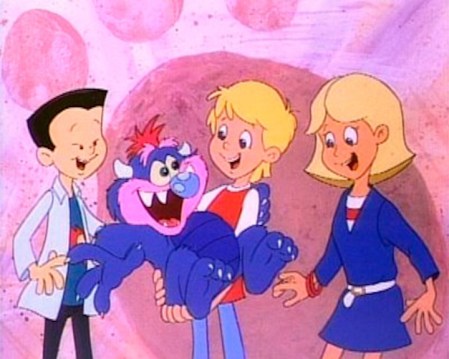
Based on a straight-to-video movie whose box art is perhaps burned into the memories of every child that grew up from the late 80’s to early 90’s that went to video rental stores often, My Pet Monster actually spawned a one-season cartoon series. But it was a plush doll for little boys first and my parents never got me one because I didn’t want one. Anyway, I was never a fan of this show mainly because I didn’t see any point to it: it’s a wacky little monster that came to life and started shit for the little boy that owned him to deal with. No thanks.
The Completely Mental Misadventures of Ed Grimley
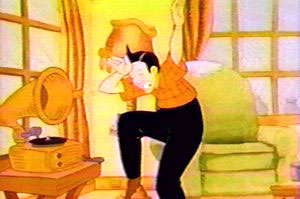
Of all the things that were inexplicably made into cartoons, Martin Short’s Ed Grimley character from the sketch comedy show SCTV, a show made for adults, is the most inexplicable. Well, it certainly appealed to me, since my parents practically raised me and my sisters on weird stuff like SCTV and Saturday Night Live. And to be honest, it’s a pretty great little show.
Ed Grimley’s completely out of his mind in the first place and placing him in a cartoon world turns that insanity up to 11. Already a very weird choice for a children’s cartoon character, the rest of the show would spin into surreal madness with Grimley at the center. Joe Flaherty would also show up in live-action segments playing his Count Floyd character from SCTV. Potentially, this show was narrowly targeted to just me and my sisters and a handful of other 6-year-olds in the Midwest whose parents had episodes of SCTV on tape they would watch with their kids. It only aired for one season for 13 episodes in 1988 on Saturday morning but it was memorable enough for me to include it on this list over 30 years later.
The Real Ghostbusters
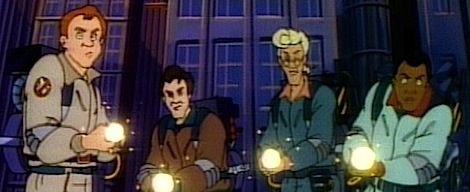
There are a few things that are damn near sacred to my generation: Back to the Future, The Goonies (or, if you had sisters like I did, The Princess Bride), and Ghostbusters. This naturally made the cartoon adaptation just as revered, although not as much as the toy line it spawned.
How many countless hours of my childhood did I have a great time playing with my Ghostbusters toys? How many flying adventures with the Ecto-1 (the Ecto-1 was granted the power of flight in my imagination) through my childhood home did it go on? How many times were Ray and Peter on the brink of my family’s laundry chute before falling into the bottomless chasm, where my mother would later find one of them on top of a laundry pile?
Oh yeah, the show was pretty solid, too. This is a big reason why the Ghostbusters franchise is still so loved by people of my age: I was 2 when the original movie came out but the right age to find the cartoon series one of the best things ever made. The concept is just fantastic and perfectly suited for a children’s cartoon, and this show was proof of that. As an adult I love the Ghostbusters live-action movies (yes, even the 2016 one, which I found unfairly maligned), but as a kid my biggest reference point to all things Ghostbusters was the cartoon series. I’m afraid to watch it now, even though it’s streaming on Netflix, because I don’t want it not to be as great as I remember it. And I still wish I had my Ecto-1 car.
Teen Wolf
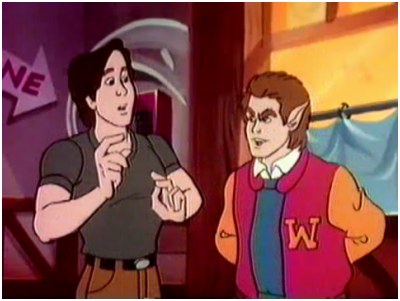
Let’s talk about the movie Teen Wolf for a moment: it’s not exactly kid-friendly. It’s about a horned-up teenager who’s a goddamn dork and can’t do a thing right and one night while making out with a girl starts to turn into a werewolf. Instead of the townspeople rising up to murder the monster in their midst, he becomes the star of his school’s basketball team? And has sex with a popular girl while being the werewolf? What the fu…
Anyway, they decided to make it a cartoon show for Saturday mornings because kids really want to be teenagers and have some asshat friend named Shades and get into stupid adventures and whatnot. The show’s….not great. It’s better than the movie, so there’s that. Here’s the theme song in case you want to lose a few brain cells while not having any fun. It’s reflective of the “quality” of the cartoon series as a whole. Question: did I watch every single episode when it aired? You bet! Nothing like adult marketers suckering little kids with crap.
Jim Henson’s Muppet Babies
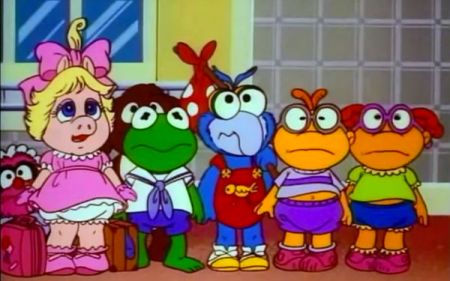
And then there’s one of the best cartoon shows for children ever made: Jim Henson’s Muppet Babies. Literally based on the one sequence in The Muppets Take Manhattan where Miss Piggy has a fantasy about all of the Muppets as adorable babies in a nursery, here’s an entire series that answers the question: what if all of the Muppets were babies? The answer: something fantastic.
Literally the first memory I have in life is me walking through my parents’ first house on a rainy day, with all the rooms dim, heading towards the TV where an episode of this show was playing. I think it was the one where they were afraid of going to the dentist, which–thanks to my trusty friend, the internet–places this at September 29, 1984 when I was 2 years old. Kind of weird knowing the exact day of your first memory, but the future’s often an inexplicably weird place. Anyway.
Jim Henson’s Muppet Babies was an adorable show featuring everyone’s favorite Muppet characters as they live in a nursery and are taken care of by their unseen (except for her green kneesocks) nanny. Each show had some sort of central problem or issue they all help each other out to solve and involved the Muppet Babies going into imagined adventures that often mixed in live-action footage of various movies.
It was a great, inventive show that spoke to kids and made the Muppet characters much more approachable for young minds to understand. It had great original songs (including the mega-ear worm theme song that I can sing literally every word of now 30+ years later by memory), top-notch animation, and great original stories centered around the imagination of kids.
Unfortunately, this classic has never had an official release on DVD since many of the rights for the live-action footage it incorporated into the episodes cannot be secured and hacking these segments out of the episodes would ruin much of the show.
Which is unfortunate, since it’s a show current and future generations of children would enjoy. I sure enjoyed it when I was a kid. Check it out on YouTube, however: there are a lot of episodes floating around there.
1990s: Original Creations
The decade’s own inventions, from slapstick lunacy to computer-generated worlds.
Wish Kid
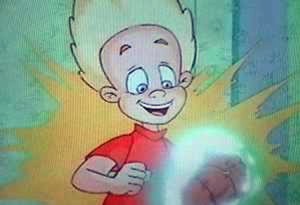
Although not specifically based on a celebrity, there’s little reason Wish Kid would have existed without Macaulay Culkin being the star and having the main character be based on him. The premise: a boy named Nick McClary has a baseball glove that was struck by a shooting star and this somehow imbues the glove with the unfathomable specific ability to grant him a wish once a week after he punches it three times, and the wish doesn’t last very long, which is convenient for a weekly cartoon show structure.
So this formulaic show goes: Nick has a problem that he tries to solve by making a wish with his magic glove, the wish works but then wears off at the worst possible moment, and then he has to spend the rest of the episode trying to get out of the jam the wish got him into.
With a live-action intro by Caulkin every episode and very little tread on its premise, Wish Kid only lasted for one season and 13 episodes. While kudos for not specifically making the protagonist explicitly the celebrity voicing it, Wish Kid is still a relatively unmemorable cartoon show that was looking to cash in on a passing fad–in this case, the human boy known as Macaulay Culkin.
Wild West C.O.W.-Boys of Moo Mesa
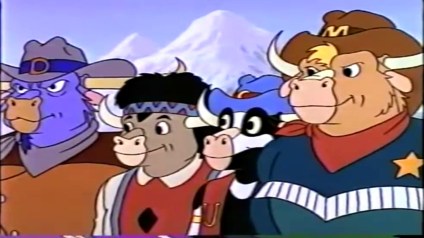
OK, here’s a tortured premise: a comet crashes into a high-altitude mesa in the 19th century Wild West that makes everything cow-like (what?) and a society develops in this isolated area inspired by the stories of the Old West they call Moo Mesa.
So…this cow-mmunity (See what I did there? That happens constantly throughout the show) has sheriffs and outlaws, including our protagonists, the C.O.W.-boys: Marshal Moo Montana, The Dakota Dude, and the Cowlorado Kid. And even though cows have become anthropomorphic, they still ride horses. And the cows wear clothes and live like people. And…I don’t know. As a kid, my brain could absorb this kind of concept better than as an adult since now it just clashes with any sense of logic and coherence that my mind now demands from its entertainment. It only ran for 2 seasons and 26 episodes but has found a weird cult following, especially online. Why do they wear clothes?
ReBoot
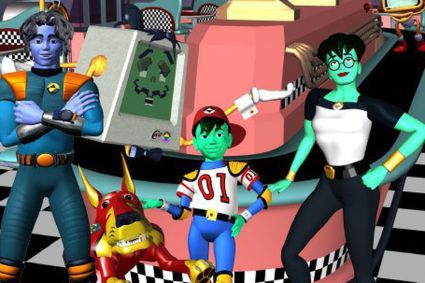
Ahh, ReBoot. Taking place in Mainframe, it follows Bob, the Guardian of this system who battles against viruses looking to take over the city. Along with his friends Enzo and Dot Matrix, Max also battles against the constantly scheming villain Megabyte, a malevolent citizen of Mainframe constantly trying to take over the city.
It was the first all-CGI TV show and it was surprisingly good and cool-looking. As a kid, I was really into computers so it was neat to see a whole TV show that takes place inside of a computer. With fluid animation, crazy villains (including nightmarish creations like Hexadecimal and goofy comedic relief like Hack & Slash) and a pretty neat formula that involves having Bob have to face off against games loaded by the user in battle spaces known as “gamespaces” that are cut off from the rest of the system. If the user wins, the part of Mainframe the gamespace was encompassing goes gray and becomes “nullified.” I always thought that was a cool idea, and the show did a great job visualizing this inner computer world.
In fact, I was surprised the show ran until 2001: it started in 1994 so when I was 12 and first saw it, I was really into it. Then as the 90’s wore on, I stopped watching Saturday morning cartoons (and now 20+ years later am writing lengthy articles about them because life’s funny but not ha-ha funny) and just figured it went off the air. But nope! It was still running when I was 19. It was still on the air after 9/11! They even made 2 TV movies! Wild. This is one of those shows I don’t want to re-watch as an adult because I’d rather it remain really awesome in my 90’s memory instead of being kind of lame in 21st century reality.
Freakazoid!
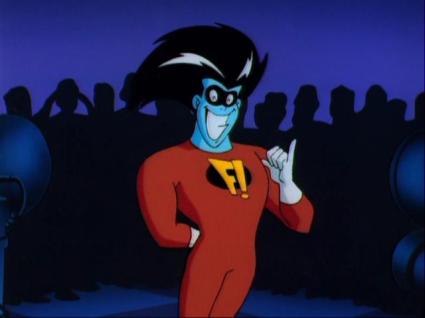
Speaking of another completely awesome show from the 90’s, here’s Freakazoid! Now, this show does hold up, mostly because I still watch episodes from time to time as an adult. Whatever smartass came up with this show, I need to write them a letter of thanks. In fact, I did look up who created it and was not surprised to find it was Paul Dini and Bruce Timm. both of whom either created or worked on many notable cartoon shows in the 80’s and 90’s.
Freakazoid! follows a pretty standard setup: geeky teen Dexter Douglas gets his powers through a computer bug he discovers after his cat accidentally types the secret code into his computer. He transfers into Freakazoid, who gains all the knowledge of the internet and super speed and endurance but also becomes a hyper lunatic who lives in a world of his own. Able to transform into Freakazoid by saying “Freak out!” and “Freak in!” Dexter is his regular average self when human but the loony Freakazoid when in superhero mode.
But more than that, Freakaoid! was the first show I ever saw (maybe outside of The Tick) that was a parody of super heroes. Freakazoid was a “hero” but mostly seemed to fight crime as an amusing distraction; being a character that knew he was just an animated superhero drove a lot of the wacky humor the show dropped on a frequent basis, and much like its main character, many of the side characters are also transparent parodies or just comedic fodder.
I could write an entire article about this show alone, but there are roughly a million cartoons demanding attention here, so I’ll spare everyone for now. But Freakazoid! was one of best cartoon shows made in the 1990’s and heck, it’s still a really funny show even today.
Eek! The Cat
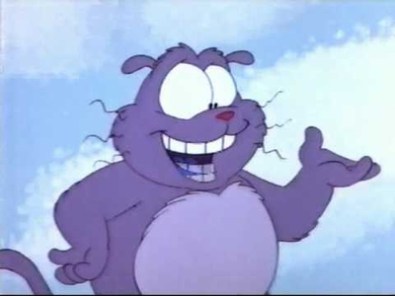
Well, here’s a cartoon show I was never a big fan of. Maybe it was because this was supposed to be some sort of warped parody of Garfield or that the comedy derived from the main character getting pulverized on a regular basis because he’s just too darn good natured not to want to help people. What this is supposed to teach kids, or why kids would like a protagonist like this, has always been lost on me.
Did I watch it? Sure, of course. I watched everything. But you know how you watched a lot of stuff on TV when you were a kid that you didn’t particularly enjoy? This was Eek! The Cat for me. In fact, I found the characters around Eek much funnier than him. Elmo the Elk and The Squishy Bearz were more amusing to me than the pushover cat that would invariably be involved in some awful misfortune. Meh. Pass.
Taz-Mania
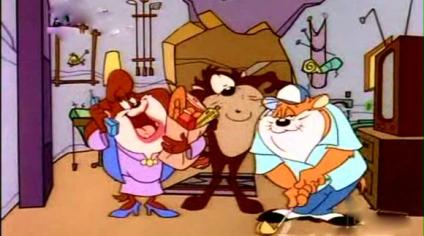
Similar to Eek! The Cat, you know what was great about Taz-Mania? Everything around Taz. His family, in particular, were much more interesting and funny characters than the one-dimensional Taz. For instance: his Bing Crosby-esque father Hugh, which juxtaposed against the incomprehensible, manic Taz is actually pretty funny.
The rest outside of his parents is kind of hazy in my memory: it was one of those shows I only paid attention to when stuff was on-screen that I liked and was background noise otherwise. But I can say one thing: it certainly was a cartoon show that was on television in the 1990’s.
Pirates of Dark Water

Pirates of Dark Water was one of those bizarre, original cartoon shows that was actually something original and interesting that hadn’t been seen on television before. Taking place on a planet called Mer, which is being consumed by a substance called Dark Water, a young prince must find the lost Thirteen Treasures of Rule to stop it. With a crew of misfits, he takes to the monster-filled sea to find it. But the evil pirate lord Bloth is also seeking the treasure and tries to stop the prince at every turn.
So this unique, exciting show ran for a whole 2 seasons and 21 episodes before being shuffled off to most likely wildly confused syndicated audiences. Which is a shame, since it was actually something different in a Saturday morning landscape filled with carbon copy cutesy kid’s shows and standard, familiar superhero fare.
Bobby’s World
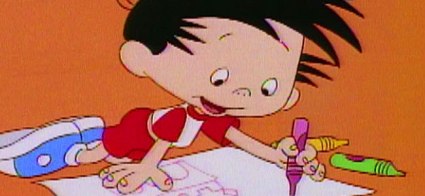
Bobby’s World is one of those shows that feels like it’s been on forever–mostly because it ran for 8 seasons, spanning most of the 1990s, to the point that its original audience outgrew it, and then a secondary audience outgrew it. I was 8 when this show started to air and 16 when it ended while Bobby aged from 4 to 8 in those years. And it was….OK?
It was a good show for kids–and pretty much only for kids. Unlike a fair amount of the cartoons on this long list that were either enjoyable at the time or at least gained an ironic enjoyability over the years due to their relatively insane concepts, Bobby’s World stays strictly for the 8-and-below crowd so that as an adult, the show comes across as tedious. It is what it’s meant to be, and hell, at least it’s better than Caillou.
1990s: From Comic Strips to Superheroes
The funny pages and comic-book shelves supplied some of the decade’s most memorable animation.
Garfield and Friends
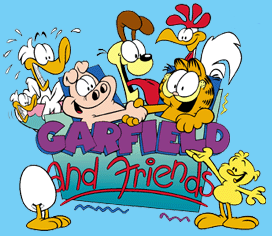
One of the more memorable cartoons from the 1990s was Garfield and Friends. A big hit with audiences, even kids that didn’t read the strip liked the cartoon series, while the “and Friends” introduced audiences to Jim Davis’s other cartoon strip, U.S. Acres, which ceased production by 1989.
Honestly, I enjoyed the “and Friends” portion of the show than the “Garfield” part. Sure, Lorenzo Music was the perfect voice for Garfield, but much like in the comic strip, I always found Garfield to be a relatively negative and hateful character. Instead, with the U.S. Acres gang, there was a small farm community with characters whose dynamics led to actual interesting stories, as opposed to Garfield being a dick about something for 15 minutes at a time.
Mother Goose and Grimm
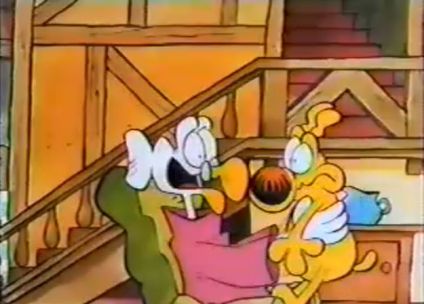
Out of all of the cartoon strips to adapt, why Mother Goose and Grimm? The comic strip was OK enough but nothing that screamed “This must be made into a cartoon show for kids!” Besides that, Grimm was just a dog version of Garfield–maybe a little more high-strung but there it is.
In fact, I remember very little about this show other than the theme song, mostly because it only ran for 16 episodes over two seasons. But this is show is notable for featuring early animation work by Stephen Hillenburg, who would go on to work on the stellar Rocko’s Modern Life and create SpongeBob Squarepants. So, thanks for providing this guy a gig, show I barely remember!
Addams Family
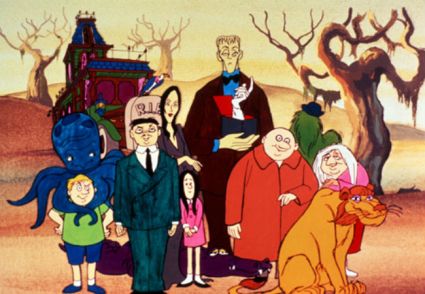
Now, I do remember the Addams Family cartoon because it was actually pretty decent. Even though it’s not as dark and nuts as the comic strips or movies (the first movie’s success in 1991 is what pushed this cartoon into production), it’s still an affecting cartoon that captures the look and spirit of Charles Addams’ original creation. Heck, John Astin–TV’s Gomez Addams–reprises his role in this show! Fester enjoys blowing himself up, and the show in general is a toned-down, slightly less insane version of the source material. Alas, it only ran for 2 seasons and 21 episodes, but it’s a solid adaptation from already fertile material.
New Dennis the Menace
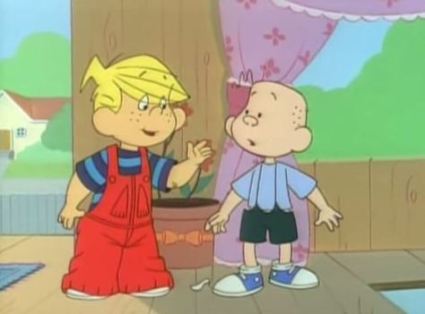
And here’s Dennis the Menace, the littlest bastard in comic strip history. I’ve never been a fan of the “ain’t I a stinker?” archetype of mischievous little boys who like to fuck everything up for everyone around them because they’re bored. And even characters that do have some traits of this have other redeeming qualities: Bart Simpson’s a hellraiser but he also has soul and truly does feel sorry when things go too far, and Calvin from Calvin & Hobbes is often unaware of the havoc he’s causing.
But Dennis the Menace knows exactly what he’s doing and he wears a shit-eating grin while doing it. Whoever they got to voice Dennis doesn’t do the character any favors, either: that kid must have been a brat in real-life because his voice has that needling little edge to it, an insouciance that gives every utterance a mocking tone. Ugh. Throw this show in the garbage along with that blonde freckled monster. Nothing to redeem here.
X-Men
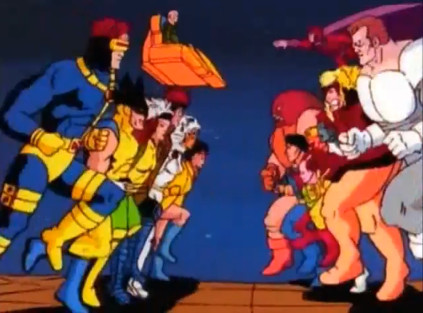
It’s weird to think that the animated adaptation of X-Men actually did better justice to the comic book better than the multiple major motion picture films they’ve made about the X-Men. Want to see a great adaptation of The Phoenix Saga? Watch how they did it on this show.
Besides that, this was my introduction to the X-Men. I didn’t read comic books as a kid (no, I saved that joy for my late teens, twenties, and today!) so when I first saw this show it knocked me out. The opening theme is so damn radical, the animation’s much more sophisticated than a lot of kids’ shows at the time, and it was surprisingly dark and edgy. While there are gripes about how potentially cheesy or off-model some characters and dialogue is, it’s still a pretty darn righteous adaptation of a seminal comic book. Hey, I’ll take three episodes of this show over X-Men: Apocalypse any day.
The Tick
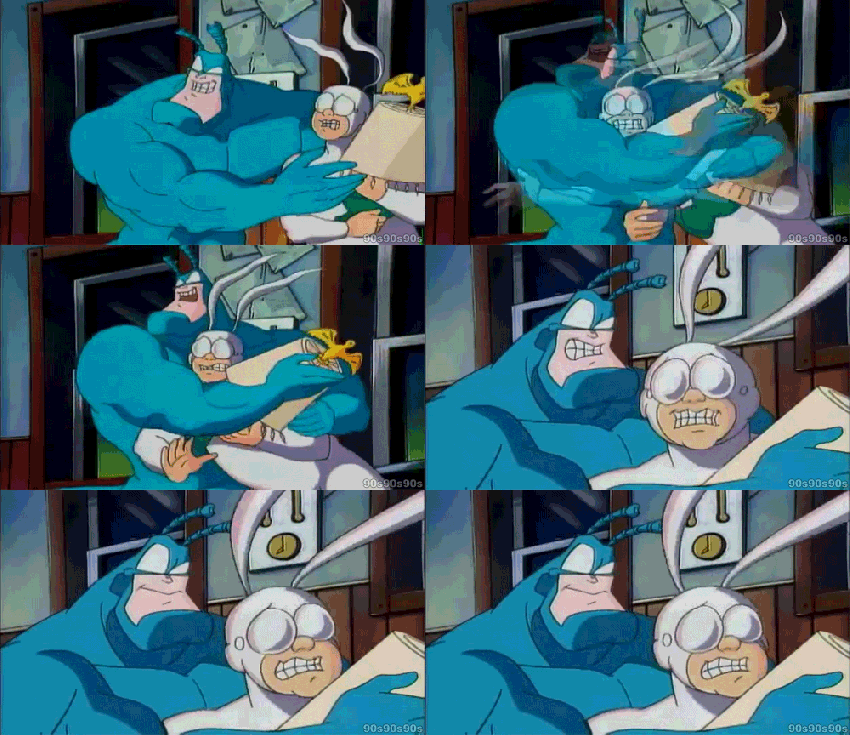
Much like Freakazoid! I could write a lengthy, rather insanely in-depth article about The Tick. Adapted from Ben Edlund’s equally comedic comic book about an 8-foot muscle-bound nigh invincible knucklehead superhero known as The Tick, who protects The City with his nebbish sidekick Arthur from ridiculous nemeses and villains, The Tick is literally one of my favorite shows of all time. I own the DVDs and still watch it to this day.
Why? Again, like Freakazoid! it was a sharp, silly parody of super heroes. The Fantastic Four get parodied as The Civic-Minded Five, Batman becomes a sleazy coward called Die Fledermous, and Wonder Woman is Miss Liberty. The villains are all wackos who come up with unbelievably stupid, mostly egocentric plans, such as Chairface Chippendale (literally a guy with a chair for a head) who wants to use a laser to engrave his name onto the moon. As a funny running gag, every time the moon is seen in the show from here on out, it still has CHA engraved onto it.
But that’s just the tip of a well-drawn universe filled with eccentrics playing out their own superhero and villain dreams, even if they’re ridiculous. And The Tick himself is one of the best superheroes ever created: he’s dense and silly, but also incredibly positive and good-hearted. His loopy speeches are delivered with conviction and passion, even if they’re completely off the rails bonkers. It’s a fun, well-made cartoon show that was funny without talking down to its audience and action-packed without being graphic or too violent. It’s just the best. SPOON!
Spider-Man
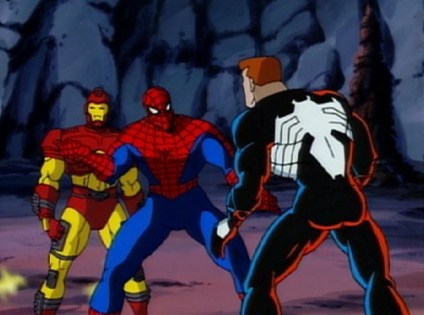
At one point in our pop culture history, people were almost saying, “Stop trying to make Spider-Man happen! It’s not going to happen.” And for good reason: there were so many false starts with this property over the decades to make it a live-action TV series and cartoon series that people were wildly skeptical when the live-action movie finally came out in 2002 and actually worked.
Since Fox owned the property, they were going to get their money’s worth well before the film was made and produced an animated series in the 1990s. The results were pretty decent: there would be long story arcs across multiple episodes that little boy nerds could appreciate, tons of characters from the original books were present, and in general it was an earnest attempt to reproduce the comic books to the small screen.
Actually, it’s kind of great how it stayed pretty close to the book, especially for all the signature villains that appear: Kingpin, Green Goblin, Rhino, Doctor Octopus, and Venom all show up. Besides that, a number of other well-known Marvel characters also appear in various episodes, including Daredevil, Blade, Doctor Strange, and Punisher. Yes, Punisher showed up in a kid’s cartoon.
So, good for this show: it ran for 4 seasons and 65 episodes and did the job it set out to do, which is be a Spider-Man cartoon that wasn’t garbage. Thanks, friendly neighborhood Spider-Man!
Batman: The Animated Series
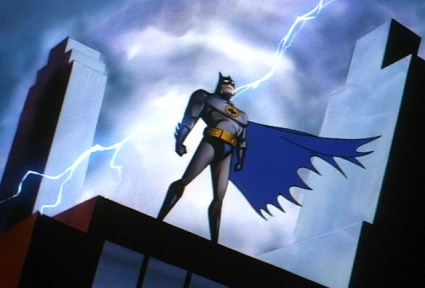
While Spider-Man did a fine job with its adaptation, Batman: The Animated Series blew the bloody doors off, adapting the series with the noirish look and feel of the original comic book from the 1940’s and setting it in that time period. This provided the show with a lot of gravitas and also made it far more interesting than if it was set in the Radical 90’s™.
The dark atmosphere, dramatic writing, stylized art, and mature themes this show approached was very different from most kid’s superhero shows at the time, which made it stand out and actually garner the appreciation of new young fans and older fans alike. Of course, all of the classic villains are present, including The Penguin, Mr. Freeze, and of course The Joker, and the voiceover work throughout is A+. Never afraid of plunging into pathos or giving even the villains truly sympathetic backstories, Batman: The Animated Series also took the character more seriously than the films of the time, particularly dreck like Batman & Robin, which is far more cartoonish than the actual cartoon that was on at the same time. Running for 4 seasons and producing 85 episodes, Batman: The Animated Series is a prime example of a comic book adapted to a cartoon done the right way.
Superman: The Animated Series
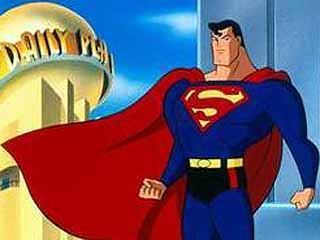
Similar to Batman: The Animated Series, Superman: The Animated Series did a better job by making it a straightforward and sincere adaptation of its source material rather than making it too up-to-date. In fact, many of the people who created the Batman animated series moved on over to produce this one, taking their reverence and understanding of the original material with them.
Of course, it being Superman, it’s much brighter and Metropolis is in general a less grim setting than Gotham City, but the well-defined stylized animation is still there, and the action sequences involving Superman are done very well.
Superman’s rogues gallery shows up to cause trouble, and the character designs of his villains are as faithful and fluid as Superman himself. Widely hailed as one of the best adaptations of the character (which I agree, to the point that I think it’s the only good adaptation of the Superman character in any format [sorry, Superman film fans: so far I’ve found them all severely lacking, both past and present]), Superman: The Animated Series ran for 3 seasons and produced 54 highly watchable episodes.
The Fantastic Four: The Animated Series
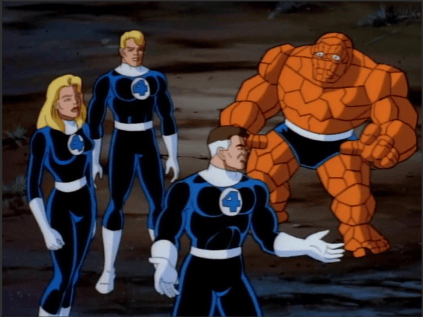
Now for an adaptation that didn’t work of a property that apparently can’t exist outside of the realm of comic books: The Fantastic Four: The Animated Series. Mind you, this is the third animated adaptation of the series up to this point, and even this one didn’t last more than 2 seasons and 26 episodes.
What is it about these characters and their world that just don’t work in cartoons or live-action films? Are they so 2-dimensional that they come off as paper-thin outside of comic books? Do their powers look silly when they’re not just still drawings?
Whatever it is, this was not a good adaptation of the comic book: it was cheap-looking, cheesy, and its faithful retelling of the early Fantastic Four storylines, while a nice attempt, were also boring for anyone that was familiar with them–which would be nearly anyone that would be interested in this show. Maybe one day they’ll actually make a decent Fantastic Four adaptation, but they sure didn’t in the 1990’s.
Cadillacs and Dinosaurs
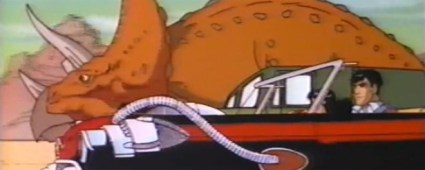
The insane, nonsensical nature of Cadillacs and Dinosaurs appeals to me even today. I had no idea this was adapted from a comic book until I was researching this article. In some insane 26th century world where dinosaurs roam the planet and ecological warriors fight against the encroaching forces trying to reclaim the land. Oh, and there are Cadillacs and dinosaurs.
Honestly, this show was everything my 11-year-old brain could have ever wanted: people and dinosaurs living together, badass dudes driving cars around and getting into fights, mass hysteria!
Somehow, this show only lasted one season of 13 episodes but ended up being so memorable that I seriously thought it was on for years. Maybe it was played a lot in syndication or maybe it was just further adventures based on the premise that I made up in my dreams, but Cadillacs and Dinosaurs was a fantastically cool, original action cartoon that thrilled at least one little boy in the early 90s.
1990s: Celebrity Cartoons
For a while, celebrity status seemed to be sufficient justification for an entire animated series.
Little Rosie
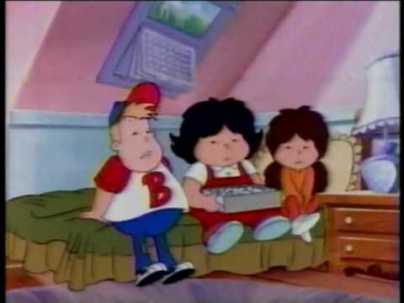
Ugh. Little Rosie. Why? Just, why? Revolving around an 8-year-old Roseanne Barr, her sister, and her best friend, the show details how these kids use their imaginations to work through their problems with pluck and imagination and who could care less?
It aired on ABC Saturday mornings in 1990, which was the same network that her hit television show Roseanne aired on, so this might have just been part of an overall development deal she had with the network, but unlike her sitcom–in which her persona makes sense–the idea of having to watch a kid version of Roseanne is unbelievably unappealing to a kid. And the rest of the US agreed since it only lasted one 13-episode season. But oh sweet merciful God, why in the first place?
Kid ‘n’ Play
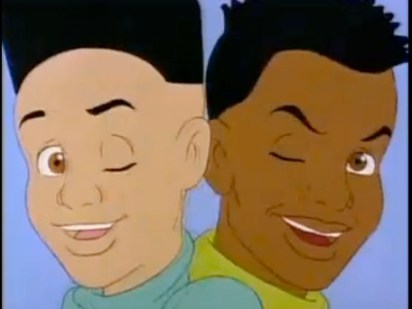
Speaking of “Oh God, Why?” here’s Kid ‘n’ Play. What’s even more bizarre is that the actual Kid ‘n’ Play didn’t even voice the characters that were based on them (what could they have possibly been doing otherwise?), this completely unnecessary show also aired in 1990 for one 13-episode season. Following the rap group as they teach the kids watching that doing the right thing and staying out of trouble is way cool, this was another example of who could care? For a cartoon show aimed at the 5-to-10 year olds of the country–who, as far as I could recall, didn’t listen to a lot of hip-hop in 1990–the actual Kid ‘n’ Play showed up at the beginning and end in live-action interstitials to hammer home the point that drinking your milk, doing your homework, and being nice is cooler than ten Super Bowls combined! Wretched.
Hammerman
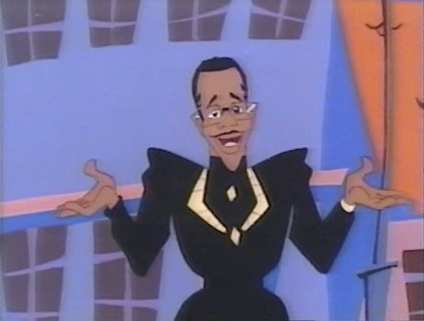
You’d think I ordered this section so I could get more disgusted with every show as it continues, but this was honestly just the arbitrary order I put it in. Hammerman was a cartoon show based on the eternally popular and successful MC Hammer. Only this time he’s a youth center worker who owns a pair of magical talking shoes. Wait, what? That’s the stupidest thing ever. Anyway, when he wears the shoes he turns into the superhero Hammerman.
This may be the worst show in this entire collection: not only is the entire setup hollow and an unbelievably cheap cash-in, but the animation is sub-basement quality. I’ve animated things accidentally better than this show that ostensibly hired professionals to do the animation. Every moment of every episode is chaotically edited, nonsensical, and overall trash. Thankfully, it only ran for 13 episodes until the network executive that greenlit it was executed behind the studio once his boss found out what he had done. Insipid garbage.
New Kids on the Block
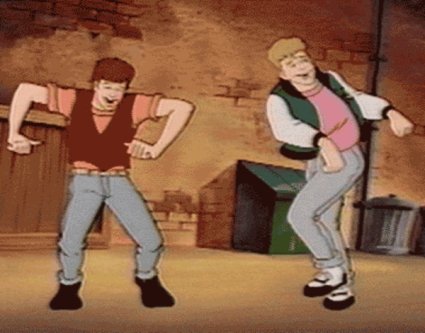
(Sighs) Yes, New Kids on the Block–the prefab pop group that was popular for approximately 18 months in the late 80’s and early 90’s–were given a Saturday morning cartoon show. They appeared in live-action segments but didn’t voice their characters, and thankfully their Wikipedia page explained why and potentially also explains why Kid ‘n’ Play didn’t voice their own characters: licensing reasons. You see, their voices couldn’t appear on other outlets that weren’t owned or at least under license agreement with their record company. So hey! At least I learned something from a show. But I’m also confused because their music is played throughout the show. Anyway, watching about three minutes of it made me feel like my brains were leaking out of my ears.
The show itself is wildly banal, usually with the animation intercut with live action “off the cuff” interjections from the actual New Kids. They’re on tour, something wacky happens, very mild hijinks ensue, and only a 7 to 10 year old girl in 1990 could have watched more than a few minutes of this. It’s really, really bad. Fortunately, it only lasted for 13 episodes. And maybe someone will do something funny with the animation one day, like make the characters talk unbelievably profane or something. I don’t know, I’m just spitballing here and this show kind of stole a piece of my soul.
ProStars
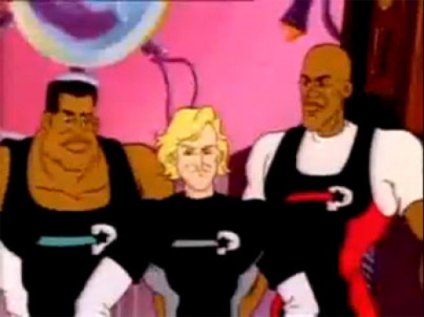
Hey! Do you love famous athletes? What with their energy, abilities, and stunning success, sports stars in the 90s were pretty charismatic popular figures. So a cartoon series featuring Michael Jordan, Wayne Gretzky, and Bo Jackson would be really exciting, especially in 1991! Only it’s one of the most low-energy things I’ve ever seen. The athletes show up for brief wrap-around live-action segments but the actual show itself is an odd mixture of formulaic action-adventure and confusing, unbelievable setups.
For example: these three athletes (of course they don’t voice their own characters on the show; why did they even do this show? Was it a tax dodge of some sort?) are also a group called the ProStars, who are a super-team of sorts that go on adventures to defeat villains and other things that aren’t the first thing you think of when you think of Michael Jordan, Wayne Gretzky, or Bo Jackson. It’s just bizarre.
Fortunately, like most of the other shows in this section, it only ran for one 13-episode season and then was forever banished to snarky lists like this where people decades into the future make fun of them on the internet.
Life With Louie
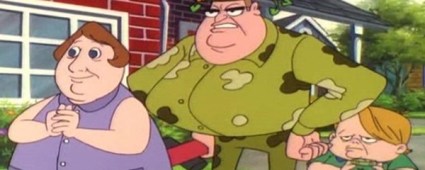
Was Louie Anderson so popular that he deserved a cartoon kid’s show of his own? Even his comedy wasn’t kid-friendly but mostly a series of observations about the frustrations and disappointments in his life. But I guess he could really sell a pitch in the room because we got Life With Louie, where Louie voices both a kid version of himself and his father as he shares stories of his childhood–his twisted, sad childhood.
His father is, to put it delicately, a complete fucking mental case that’s on the verge of having a heart attack in the middle of his constant raging while Louie the child sarcastically comments upon his father’s madness. It’s pretty damn depressing for a kid’s show.
So you must be thinking, this is another one of those one-season oddities, right? Nope! This ran for three seasons and 39 episodes. Why? Who was watching this? Whenever I caught an episode, I felt like killing myself at the end of it, and I was a pretty happy kid overall.
Super Dave: Daredevil for Hire
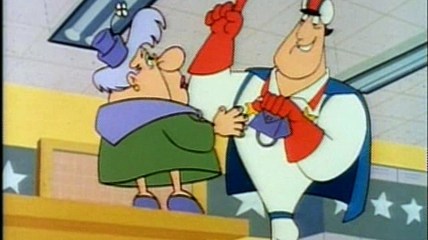
I’m still not sure what a Super Dave is. I get that it was some sort of parody of Evel Knieval, a stuntman from the 1970s, only this one never successfully completed his stunts. Get it? Neither did I, but this character was more for Gen Xer nostalgia or something. I’m still not completely sure.
It’s not like the show stuck around for that long: it was one season and 13 episodes between 1992 and 1993. Hey, did you know the guy who does Super Dave is acclaimed director and comedian Albert Brooks’ brother? Too bad they never gave Albert Brooks his own cartoon show: I’d still be watching that if they did.
1990s: Hollywood’s Cartoon Adaptation Factory
The movie-to-cartoon pipeline, from logical spin-offs to adaptations that make you wonder who attended the pitch meeting.
The Little Mermaid
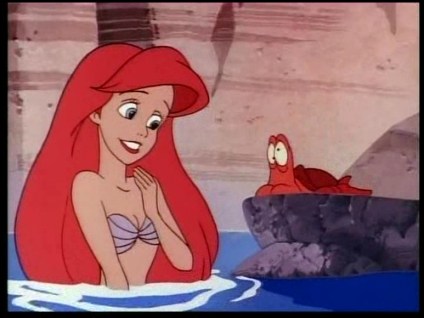
In an adaptation that for once makes sense, The Little Mermaid was a Saturday morning cartoon show that aired on CBS, before Disney just took over the 90’s TV cartoon world with the syndicated Disney Afternoon. Notable for being the first TV adaptation of an animated Disney movie, the series takes place before the events of the film, with Ariel flippin’ her fins but not getting too far. The side characters are all there, including Sebastian and Flounder, and expands on her world and her relationships with her friends, sisters, and father. Of course, evil villains are always scheming to take over the underworld kingdom, so Ariel and company need to figure out how to defeat them.
It’s pretty standard Disney animated TV show material, but it was actually a pretty decent adaptation of an existing property. Disney must have seen how well they did with this and how easy and profitable it was and then purchased ABC to take over their Saturday morning until finally the gargantuan machine just said to hell with it and brought their show on the syndication road. It ran for 3 seasons and 31 episodes and kudos to Disney for making something worth half a damn for the Saturday morning audience.
Jumanji
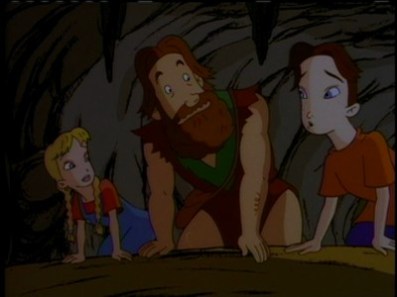
Hey, remember Jumanji? I don’t because I’ve never watched that movie. But apparently kids at the time did and enjoyed it enough that some greedy network executives tallied how much it would cost to pump out a few seasons of a cartoon show against how much money they could make from the advertising and then sent a rush order to the twelfth circle of Hell (where wicked animators must grind out cheap, shitty animation for all of eternity) to produce it
So there was Jumanji the animated series. I don’t know, I guess they keep getting sucked into the game trying to save the poor bastard that’s been stuck in there for decades. Who cares? It ran for 3 seasons and an unbelievable 40 episodes at a cost that was probably more than my entire life is worth. It’s stuff like this that drives me to drink.
Free Willy
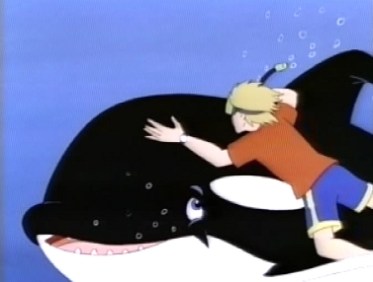
There was also an animated show based on the feel-good movie Free Willy, which doesn’t make sense because–much like Jumanji–it seems that once the problem’s resolved there’s nowhere else to go. Does that stupid whale keep getting captured?
Well, the solution to this plot wall is even crazier: the kid from the movie, Jesse, finds out he can talk to animals. And so now Willy–and all of the animals Jesse encounters–also talk. And the main villain is a Captain Ahab-esque nutbar that lost some limbs to Willy because Willy is a killer whale that will eventually, you know, try to kill you.
I really don’t know. If I saw this show, I don’t remember it and wouldn’t have watched it anyway. It ran for one season and 21 episodes and I can’t even bring myself to watching any clips because that magical talking animal bullshit in cartoons kind of drives me up the wall.
Attack of the Killer Tomatoes
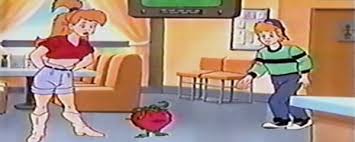
I almost left this one out altogether, which would have been a crime against cartoon absurdity. I loved this show when I was a kid. Not surprisingly, it was in the same snarky parody vein as The Tick and Freakazoid! But the story behind how this weird late-70’s parody of monster films turned into a Saturday morning cartoon in the 1990s is somehow even better, and it starts with Muppet Babies.
So, in one episode of Muppet Babies in 1987, a segment called “The Weirdo Zone” (a parody of The Twilight Zone) was called “Attack of the Silly Tomatoes” which used clips from the movie. The producers of Muppet Babies found that the episode pulled very high ratings and approached the production company that made the original movie to make a sequel. Initially they declined but then the Jim Henson Company drove up to their house with a dump truck full of money, and Return of the Killer Tomatoes was made. It was a big hit, so a few years later the same production company was approached about making a cartoon show based on the property and–after taking a bath in gold dubloons, I’d imagine–said yes.
The animated series is as snarky and meta as possible, making clever pop culture and genre references, along with poking fun at itself and the ridiculous nature of both the show and the characters. It was smart and silly and like very little else on Saturday morning. It’s one of those shows I’m scared of watching as an adult so my memories aren’t tarnished, but I just might have to take the plunge. It ran for 2 seasons and 21 episodes, so hopefully it’s still just as funny as I remember so I have hours of nostalgic entertainment ahead of me.
Fievel’s American Tails
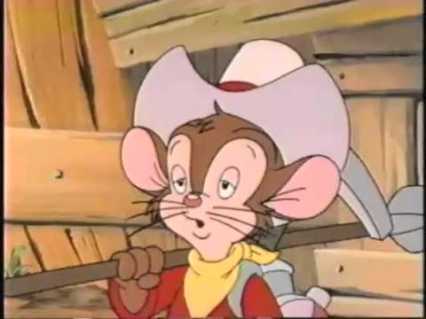
This is one of those adaptations that I understand on a logical level why they would make a cartoon series out of it but on an emotional level wonder why the hell they would bother. If Life With Louie didn’t deliver enough nihilistic darkness that permeated your soul, was Fievel’s American Tails’ blubbering sentimentality supposed to finish the job?
Anyway, the series takes placed after Fievel Goes West and it’s insipid. Then again, I found the character and the movies insipid even as a child, so there was no way I was going to spend a half hour every week to watch that whiney little mouse get into scrapes and get sad and whatever else happened in this series. It lasted one season and 13 episodes. I hope it made somebody happy somewhere out there.
101 Dalmatians: The Series
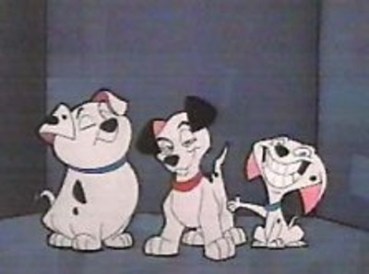
Like many of the shows on here, I wonder why some things were made into cartoon shows for Saturday morning. For example: 101 Dalmations. After all, the original movie’s a classic and the later animated movie has some good points, and the live-action movie kind of sucked, but isn’t there a point in time where we can just call it a day on some ideas? Apparently not. Kids at the time still enjoyed the 101 Dalmatians movies enough that Disney said, “wait a minute! We just purchased ABC! WE CAN DO WHATEVER WE WANT!” And then Michael Eisner and Mickey Mouse laughed and laughed long into the night.
You can imagine what this show was: following the adventures of various puppies from the giant brood as they get into all sorts of scrapes and shenanigans. This aired in 1998, way after I stopped watching Saturday morning cartoons, so I’m really griping about something that wasn’t made for me in the first place. But I’m a neurotic enough completest that I simply had to include it in the list of “Cartoon Shows Adapted From Movies” so my soul may one day find peace in the afterlife.
Back to the Future: The Animated Series
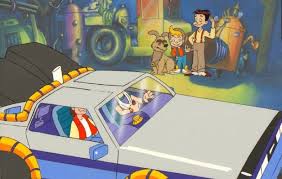
Talk about shooting fish in a barrel, but then missing the barrel completely and hitting your own foot instead. If there was ever a movie property tailor-made to be adapted into a kid’s cartoon, Back to the Future was it. Could you imagine the possibilities? Doc and Marty travelling through time in their flying Delorean, getting into all sorts of jams and creating paradoxes they have to race to fix? They could go to Ancient Egypt or Rome, or to the Jurassic period, or even to the distant future! The possibilities are literally endless!
But–instead of focusing on the two beloved, well-known characters from the BttF films, guess what this series focused on? Jules and Verne. You know, the two kids who appeared for less than 5 minutes in the last scene of the last movie and didn’t say a word? They were the stars of the cartoon. It’s almost unfathomable what a miscalculation this was on the producers’ part. They were petulant, whiny little brats who kept going back in time and screwing everything up, but more than that: who could care? It wasn’t Doc or Marty (although strangely enough, Christopher Lloyd did show up to do live-action segments as Doc Brown, but was voiced in the cartoon by Dan “Homer” Castellaneta).
To be fair, Marty did appear in episodes and go on some adventures with Doc–they even traveled back to prehistoric times–but the cartoon was still a let-down. A great example of how not to execute a sure-fire concept, Back to the Future: The Animated Series was cancelled after just two 13-episode seasons. But with all the reboots going on these days, it wouldn’t be a surprise if we don’t see a flying, time-traveling Delorean coming soon to a theater near you.
Bill & Ted’s Excellent Adventures
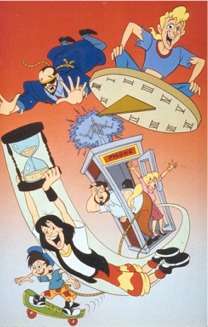
Speaking of time travel adaptations: Bill & Ted’s Excellent Adventure was a fun, surprisingly clever comedy from 1989 that was a fun riff on the then-popular Back to the Future. The two dopey California rocker dudes (the titular Bill S. Preston, Esquire and Ted Theodore Logan) with a time-travelling telephone booth indeed had a most excellent adventure, so producers thought to themselves, why not more excellent adventures?
And so the animated series was born, and for a while it was good. Keanu Reeves and Alex Winter reprised their roles to voice the characters, as did George Carlin as Rufus, and this series actually did what Back to the Future didn’t: they actually delivered the kind of show the audience expected. Every episode, Bill & Ted are faced with a dilemma that they fix by using the time-traveling phone booth to go back in the past and remedy. Whether destroying something in the present and needing to fix it or just going back to learn something for school, it was the two main characters from the movie doing the thing that people liked in the first place: going into the past and being radical 20th-century dudes with ‘tudes.
But the second season of the show was completely different: different production company, different channel (switching from CBS to Fox Kids), and the main voice actors walked. Also, the show became much sillier, with new devices being introduced that could take them into books and TV shows, which is stupid. It was cancelled after the second season, being an example of how a good idea was initially adapted correctly into a cartoon show but then was completely wrecked by destroying all of the things that made it good in the first place. Bogus!
Ace Ventura: Pet Detective
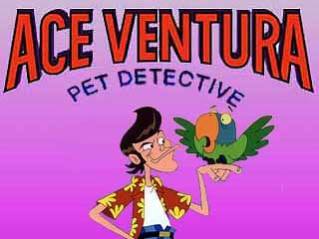
Jim Carrey was such a mega-star in the 1990’s that not one but three movies he starred in were adapted into cartoon shows. Of course, he wouldn’t voice the characters or touch these properties with a 10-foot pole, but they were made anyway because TV producers like money.
First up is Ace Ventura: Pet Detective. A PG-13 movie that leaned heavily on the 13, Ace Ventura is both an obvious and strange choice to make into a kid’s show. The animated show replaced the more gross, sexual humor of the film with overblown slapstick and a more appropriate tone for kids but with less actual humor involved.
Incredibly, this show lasted for three seasons and 39 episodes, switching from CBS to Nickelodeon for a 13-episode final season, ending just as the century turned and the 90’s faded into history. A completely unnecessary cartoon show with little entertainment value and no reason to ever watch, it certainly was something that existed at some point in time.
Dumb & Dumber: The Animated Series
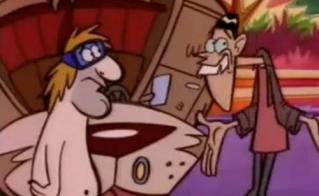
Another rather adult Jim Carrey property adapted into a cartoon show for kids was Dumb & Dumber. Like Ace Ventura, it was rated PG-13 and had a lot of inappropriate content for children. But hey, kids still liked Jim Carrey a lot so here’s some more familiar crap for them!
And boy, was it crap: paired with a purple beaver(?), Harry and Lloyd continue on as the biggest idiots in the world, only now rendered in unbelievably cheap animation and woefully unfunny gags. You know how Cracked was like the crummy version of MAD Magazine? This cartoon is like the Cracked of every other cartoon show ever made. Thankfully, it only lasted for 1 season and 13 episodes before ABC banished all non-Disney cartoons from its Saturday morning lineup.
The Mask: Animated Series
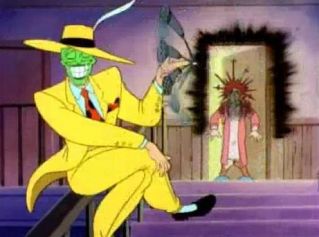
The Jim Carrey juggernaut continues to roll as we get the animated adaptation of The Mask. It actually aired before Ace Ventura: Pet Detective in its time slot, which meant for one solid hour a week two cartoons adapted from Carrey movies aired. Arguably the most successful adaptation out of the 3 Carrey movies made into cartoons, this shouldn’t come as a surprise since the actual character of The Mask is a living cartoon.
Voiced by voice-over legend Rob Paulsen, whose actual talent was able to handle the numerous characters and wild voice modulation of the Mask character, it featured actual decent animation and an appropriately hyperkinetic style for such a manic premise.
It was also the longest-running Carrey movie-adapted cartoon, running for 3 seasons and 54 episodes. A classic 90’s cel animated show with actual storylines and an interesting main character, The Mask: Animated Series is one of the rare cartoons adapted from movies that actually succeeded at representing the original content.
The Wizard of Oz and The Oz Kids

Not one but two cartoon adaptations from The Wizard of Oz existed in the 1990’s. The first was cleverly titled The Wizard of Oz, airing in 1990 and following the canonical Oz that was developed in the 1939 film. In this, Dorothy returns to Oz by using the ruby slippers and meets back up with the scarecrow, the tin man, and the lion to save Oz from yet more danger. The animation was pretty decent but the concept of Oz ends up being pretty thin soup for multiple 22-minute episodes. Running out of gas quickly, it only ran for 1 season and 13 episodes.
The second Oz show was The Oz Kids that ran on ABC in 1996. This was like The Muppet Babies crossed with The Wizard of Oz. Here, all the familiar characters from the property are present but for some reason, they’re all kids–including a kid scarecrow and kid tin man, which doesn’t make any ontological sense. It was meant for a young audience, and it’s relatively mind-numbing. Somehow, it outlasted the first animated iteration, running for 1 season but for 26 episodes. Like the former, it ran out of steam quickly because how much is there to say about Oz, really?
Little Shop
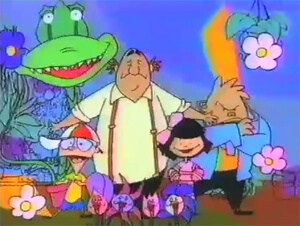
So here’s something relatively insane: a kid’s cartoon adapted from the off-Broadway musical and movie Little Shop of Horrors. You know, that comedic musical that featured domestic abuse and a protagonist that murdered and fed people to the giant plant in his flower shop? Why not make it for kids, asked the then-nascent Fox network, and in 1991 the animated series Little Shop aired. And then it was canceled after 13 episodes because in no way was this a good idea.
The theme song was so radically early 90’s that it’s almost admirable, featuring a rapping Venus fly trap called Junior (not Audrey II, as it was named in the musical). In the show, Seymour is a nerdy kid that works in the flower shop after school, Junior can hypnotize people (like in the original 1960 movie), but doesn’t eat them–except for Seymour’s piano teacher. And the abusive dentist is replaced by a generic bully called Paine Driller. Also, Audrey is now flower shop owner Mr. Mushnick’s daughter. Anyway, Junior helps Seymour out in one way or another. Oh, and there are musical numbers, which were the highlight of the show, which isn’t saying much.
But who cares? This was an incredibly cheap-looking show that needn’t exist but Fox must not have had a lot of properties at the time to adapt into shows. They were trying to edge into the Saturday morning money bonanza at the time but made a few missteps along the way–with Little Shop being a notorious example.
Problem Child
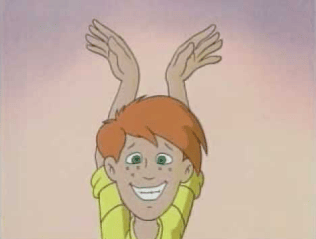
Speaking of wrong-headed notorious examples, there’s the animated adaptation of Problem Child. Adapted from the gross-out kids movie of the same name, Junior is a bratty adopted kid who ruins everyone’s lives on a constant basis because he’s the worst.
Weirdly, it was an original cartoon series that aired on USA on a block of programming called USA Cartoon Express. Although I have no memory of either this show or that programming block existing, the internet tells me it did so I’m inclined to believe it.
About the show: it’s terrible. Watching the show is like a slow death. It may be because the only episodes I could find to watch online were dubbed into Ukrainian, but even on a visual level the show is obvious garbage. It’s like, if you got the joke from the first movie (Adults are conniving jerks! And this kid’s a real jerk, too!), imagine watching a poorly animated version of that for 22 minutes at a time. Incredibly, Problem Child lasted 2 seasons and 26 episodes. I could barely get through one episode before wanting to track down the animation studio that produced it so I could burn it to the ground. Come to think of it, that may be why the show eventually stopped being made.
Beethoven
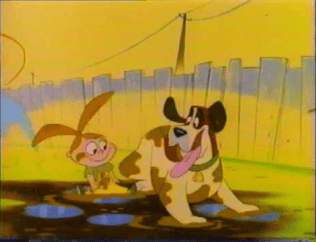
Speaking of one-joke movies: remember the Beethoven series of films? Where a fussy dad has to contend with his family’s big, slobbering, destructive Saint Bernard? Well, someone must have fallen out of their studio window, woke up with a concussion and saw a poster of the film on the side of a sound stage and thought, “Why the hell not?” and adapted it into a cartoon show.
Besides being at times stomach-churning due to the dog’s disgusting habits and actions, the goddamn dog talks. And so do all the other dogs! My brain would have been screaming at me if only the show provided one quiet moment when an annoying character wasn’t speaking, music wasn’t playing, or bonkers sound effects weren’t bouncing around on the soundtrack.
Running for one season on CBS from 1994-95, 26 insanely irritating episodes were produced. How many starving children that could have been fed with the money that went into producing this crap hopefully haunts the producer’s dreams to this day.
Godzilla: The Series
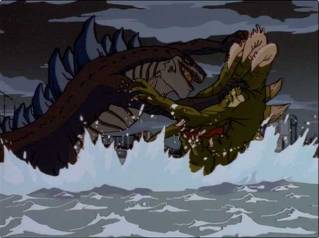
Fox kept trying to nudge its way into the Saturday morning game throughout the 90’s to varying degrees of success. In 1998, after the sub-par film Godzilla, they adapted elements of the movie into a cartoon show, titled Godzilla: The Series. In this, Godzilla’s actually a good guy or lizard or whatever, who teams up with an organization called the Humanitarian Environmental Analysis Team, or H.E.A.T. for short. Godzilla’s function here is to battle giant monsters, who now attack New York City with alarming frequency.
And the show actually wasn’t half-bad. The animation was good, the concept was solid, and the voice talent behind the show–including Frank Welker, Ian Ziering, Tom Kenney, and Paget Brewster(!)–was impressive. But it was sunk since Pokemon, Digimon, and all the other -mon crazes swallowed up the Fox Kids block.
After 2 seasons and 40 episodes, it was cancelled–which is just as well, since after 9/11 the opening credit sequence–which depicts shots of the Twin Towers, Godzilla climbing the Empire State Building, missiles being fired by the military in downtown NYC, and horrifically a monster that has managed to destroy the Twin Towers–would have guaranteed its cancellation anyway. Still, Godzilla: The Series was a surprisingly solid adaptation from a live-action movie that was better-received than its origin material.
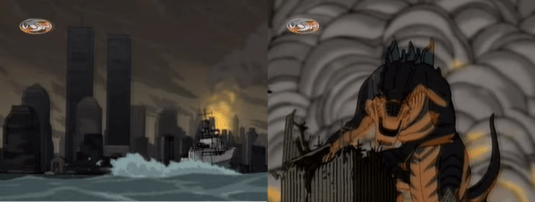
Nope, nothing wrong with this imagery post-9/11.
Men in Black: The Series
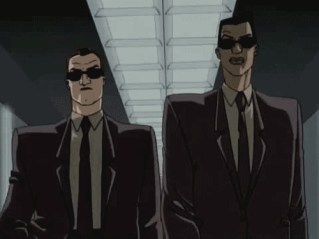
Speaking of actually good movie-to-cartoon adaptations, there’s Men in Black: The Series. Following the continuing adventures of J and K as they hunt down alien outlaws on the planet Earth, MiB: The Series was part of the WB Kids’ programming block from October 1997 to June 2001. Producing 53 episodes over 4 seasons, it was one of the longer-running and more successful movie-to-cartoon adaptations of the decade.
Not much else to say about this series other than it took a great idea for a cartoon adaptation and actually adapted it into a show that was enjoyable, well-animated, and understood both its source material and what made it worth adapting. Moreover, it showed that live-action movies can be adapted to cartoons made for kids–as long as the source material actually lends itself to animation and being appropriate for kids. Unfortunately, as the movie adaptations in this section demonstrate, that line of thinking was not always observed.
1990s: The Weird Outliers
The misfits, strange premises and shows that refused to fit neatly into any other category.
Gravedale High
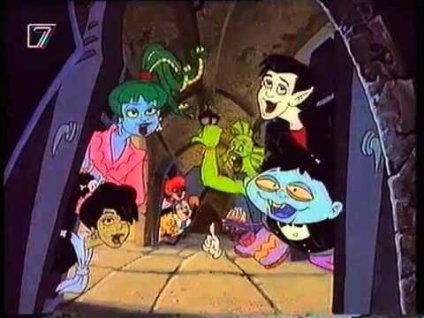
In one of the more bizarre shows I’ve ever seen, Rick Moranis plays a middle-aged school teacher who works at a high school that monsters and ghouls attend. Why? What was the impetus for this show? Who was this show for and why did anybody put any money into making this show?
Then I looked up who the creator of the show was: David Kirschner. And his film credits as a producer are impressive enough: his work includes the American Tail movies, the Child’s Play franchise, Hocus Pocus, and Frailty. OK: so he likes animation and ghoulish stuff. Then I looked at his television producer credits and it all made sense: the cartoon adaptation of Bill & Ted’s Excellent Adventures, The Pirates of Dark Water, Fievel’s American Tails, Capitol Critters, and Fish Police. In other words: he kind of liked making crappy animation for TV.
Well, I’ll give this show this: it’s certainly one for the WTF Files. It doesn’t make any sense and the appeal is non-existent. Again: who was this show for? Apparently nobody, since it only survived one 13-episode season.
Tales from the Cryptkeeper
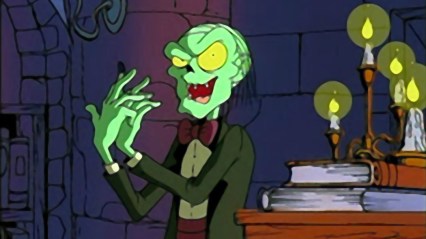
Hey kids! Do you like rotting skeletons that make awful puns involving death and murder? Too bad! Here’s Tales from the Cryptkeeper. With the episodes taking place in fictional Gravenhurst, California, it followed the live-action series format of telling three separate scary stories in each episode. Toning down the gore and scarier elements so kids can watch it, it’s still a rather grip concept for children. Amazingly, it ran for 3 seasons and produced 39 episodes. Come to think of it, maybe I have to check this one out again.
Baby Huey
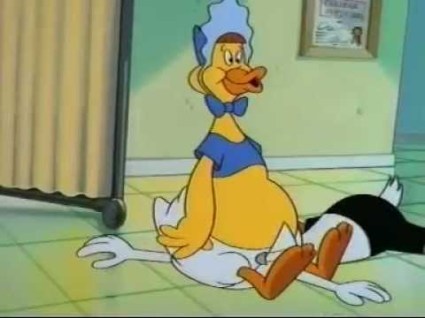
What. The hell. Was this all about? Baby Huey is about, and I quote DIRECTLY from the incredibly brief Wikipedia page about the show, “A large, dimwitted baby duck wreaks havoc on those who he comes in contact with as his attempts to help and or play result in hilarious consequences.” I remember this show pretty well and it drove me up the goddamn wall. It must have aired before something I actually wanted to watch.
Why? Did adults just think that kids found annoying, stupid, unlikable characters inherently funny? Well we didn’t. And this show was awful because the main character came across like a disturbed giant baby. I mean, I’ll even take this kind of shit from Dennis the Menace because he’s at least human, but a giant idiot duck? No way.
Unfathomably, it ran for 2 seasons and 26 episodes. Oh sure, something objectively awesome like Cadillacs and Dinosaurs could only last for 1 season and 13 episodes, but let’s make sure the cartoon about the mentally challenged duck runs for twice as wrong. There is no justice in this 90’s world.
Cro
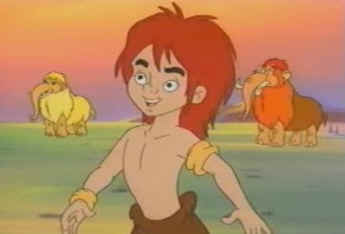
This show was funded by the Children’s Television Workshop and strove to include educational content about physics and mechanical engineering. How did it do that? By featuring a talking wooly mammoth named Phil that is thawed by a scientist in Antarctica. When the scientist comes across a physics problem he can’t figure out, the wooly mammoth recalls a situation from the distant past that reminds him of a solution, with the stories featuring his human friend Cro, the only fully evolved one in his town who is smarter than everyone else and hated for it. Cro usually comes up with the smart solution to the problem they’re facing and this helps the scientist in the present figure out his own problem.
And that’s all well and good, but what about Cro? He’s been dead for hundreds of thousands of years at this point, and that’s a downer. If you were smart enough to understand the lessons on physics they were trying to impart, you were smart enough to do the math and realize Cro’s been dead since the Ice Age. In fact, every character in the past is long dead, and that’s kind of a heavy trip to lay on a kid on a Saturday morning.
Growing Up and Away
As you can tell from this article, nostalgia for the 1980’s and the pretty wonderful childhood American culture provided me still looms large in my mind, and I’m pretty sure it still holds a strong sway on my generation as a whole: after all, we grew up only to reboot and reintroduce many properties back into the culture to make them part of our own children’s childhoods.
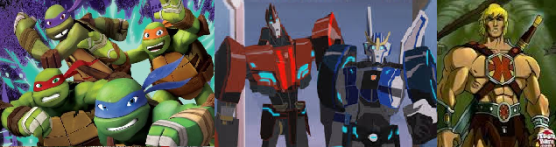
And it may be silly for a grown man to look back at cartoon shows that aired 30+ years ago that he enjoyed as a 5-year-old and then write about them with sincerity and admiration. I’ve taught at the college level, for God’s sake, and am nearly 40 with a child of my own.
Instead, I grew up and away from childhood, as everyone is destined to, and now look back at the shows and toys and time period that I spent my own childhood in with a mixture of fondness and sadness. I hope that my daughter will have such a childhood to look back on with the same.
From the archive: This reflection originally closed Totally 80s: Cartoons!. The age references reflect when that essay was written.
Editor’s historical reference: The FCC’s 1984 change to children’s-TV advertising policy helped enable the toy-linked cartoon boom discussed above. Background on the commercial explosion of 1980s cartoons.
From the Me Like Movies Archive
This new guide reorganizes and preserves material from 37 Saturday Morning Cartoons From the 90s, Twelve 90s Cartoons Adapted From Movies, and Totally 80s: Cartoons!. The three original articles remain available in full.
More ’90s nostalgia: Visit the Radical ’90s archive for television, movies, and other dubious cultural treasures from the decade.


Leave a Reply