
There was no better time to be a disaffected American suburban teenager than the 1990s. The Cold War was over, the economy was booming, technology was advancing at an astonishing pace, and the United States had emerged as the world’s undisputed superpower. The future seemed not only bright but positively blinding in its possibilities. America had won history, apparently, and all that was left to do was enjoy the spoils. Naturally, the teenagers were miserable. And why wouldn’t they be? Their parents were embarrassing, their teachers were idiots, their classmates were insufferable, and the entire culture seemed determined to market them a lifestyle of prepackaged rebellion, complete with baggy jeans, alternative rock, and a $34.99 flannel shirt purchased at the mall. Being a teenager in the 1990s was an exercise in resisting a society that desperately wanted you to enjoy yourself, preferably by purchasing something.
Into this peculiar cultural environment came Daria, an animated series that premiered on MTV in March 1997 and followed the daily misadventures of Daria Morgendorffer, a highly intelligent, deeply sarcastic teenage girl living in the fictional suburban community of Lawndale. Created by Glenn Eichler and Susie Lewis Lynn as a spin-off of Mike Judge’s wildly successful Beavis and Butt-Head, Daria was something of an oddity for MTV: a quiet, literate, character-driven comedy about a girl who was profoundly unimpressed by practically everything, including MTV’s own manufactured youth culture. Rather than being presented as a sexpot, a party animal, a ditz, or some other teenage archetype assembled in the marketing department of a multinational entertainment conglomerate, Daria was simply a smart kid who thought the world around her was full of shit.
And, largely, she was right. What makes Daria so fascinating nearly thirty years after its premiere is how completely it captured the waning years of the 20th century, when its comfortable suburban teenagers could afford the luxury of being cynical about a society that provided them with extraordinary opportunities. Daria was a show about the contradictions of being young in a society that was simultaneously optimistic about everything and contemptuous of itself. No television series better captured the peculiar atmosphere of prosperous, absurdly self-conscious American suburbia at the end of the century.
Welcome to Lawndale
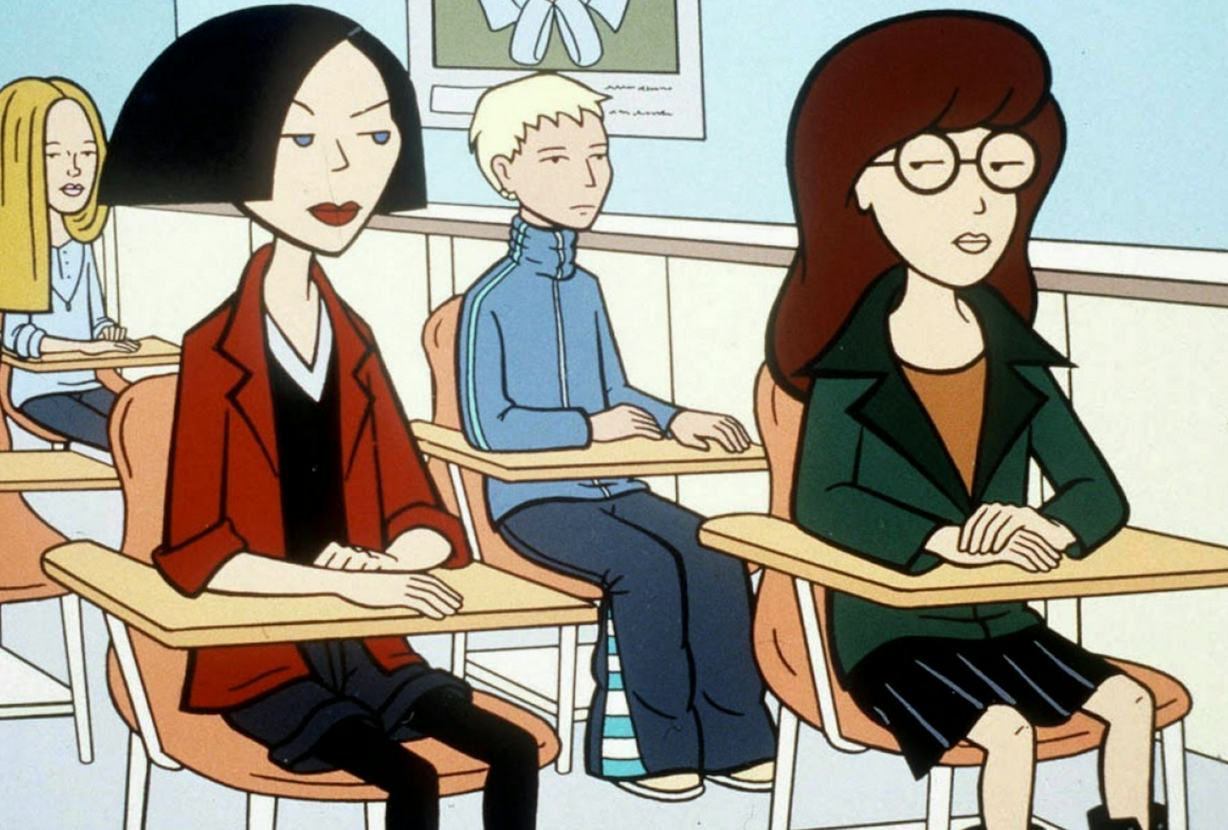
The premise of Daria was remarkably simple. After being transferred from the town of Highland (the setting of Beavis and Butt-Head), Daria and her family settle in Lawndale, a well-maintained American suburb populated by the usual collection of ambitious parents, insecure teenagers, self-important educators, and middle-class eccentrics. Daria, voiced with a wonderfully flat, almost aggressively disinterested monotone by Tracy Grandstaff, is an intellectual outsider at Lawndale High School. She’s smart, bookish, sarcastic, and utterly uninterested in participating in the elaborate social rituals that consume her classmates. Her younger sister Quinn, meanwhile, is a popular, fashion-conscious girl whose primary concerns revolve around clothing, boys, and maintaining her position within the school’s social hierarchy. Their mother Helen is an ambitious, perpetually overworked attorney, while their father Jake is a neurotic advertising consultant whose simmering resentments toward his own upbringing occasionally explode into spectacularly embarrassing outbursts.
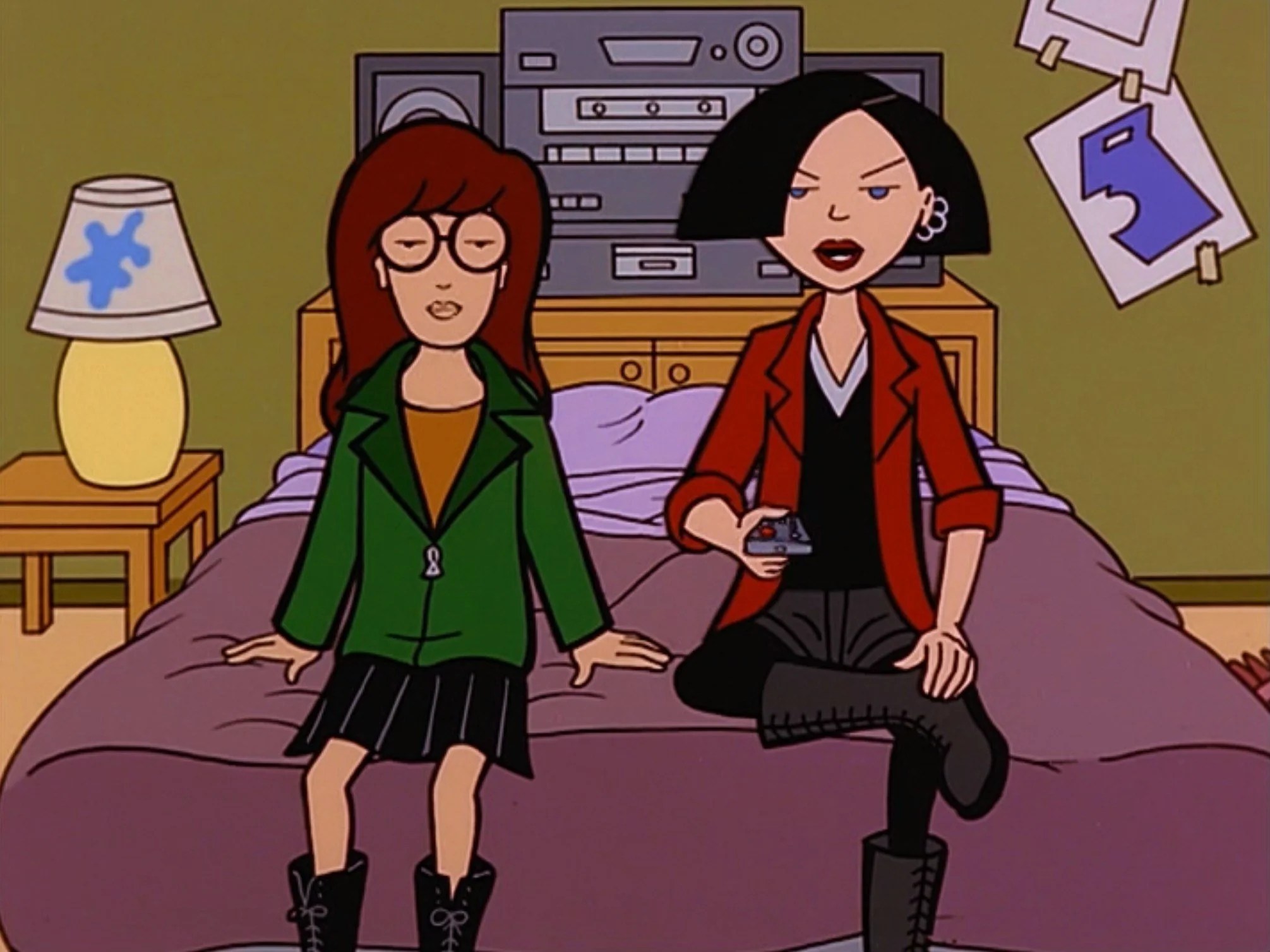
Daria’s only real friend is Jane Lane, an aspiring artist with a similarly cynical worldview, whose own bohemian family provides a counterpoint to the Morgendorffers’ upper-middle-class conventionality. The two girls spend much of their time together watching the sensationalistic television program Sick, Sad World, wandering around Lawndale, or attending school and making withering observations about the assorted imbeciles surrounding them. And what a collection of imbeciles they are. There’s Kevin Thompson, the school’s quarterback and a young man whose intellectual capacities suggest his brain has been replaced by a particularly enthusiastic golden retriever. His girlfriend Brittany is a cheerleader whose squeaky voice and relentlessly cheerful personality conceal a surprising ability to manipulate the idiots around her. There’s the self-important student government president Jodie Landon, the perpetually anxious overachiever, and Mack, Kevin’s comparatively intelligent and long-suffering teammate.
Then there are the faculty, including the militaristic principal Angela Li, whose obsessive devotion to school security and institutional prestige borders on psychosis, and the emotionally unstable English teacher Mr. O’Neill, whose progressive educational philosophy seems to consist primarily of encouraging students to express their feelings until everyone in the room is uncomfortable. It’s a wonderful collection of characters, drawn broadly enough to be funny but grounded in recognizable types that anyone who attended an American high school during the 1990s would immediately understand. And the beautiful thing about Daria is that none of these characters really understand that they’re ridiculous. Except Daria, of course. But even she isn’t always right.
The Luxury of Cynicism
One of the defining characteristics of American youth culture in the 1990s was its almost pathological devotion to irony. This was the decade of Seinfeld, The Simpsons, grunge music, alternative comedy, slacker films, and the great national pastime of making fun of anything that appeared remotely sincere. Advertising executives discovered that the most effective way to sell young people products was to openly acknowledge that advertising was bullshit, then proceed to sell them products anyway. The entire culture was engaged in a strange, circular performance of self-awareness. Corporations marketed rebellion. Television networks mocked television. Musicians became enormously wealthy by criticizing commercialism. And teenagers bought expensive clothing designed to make them look as though they didn’t give a shit about clothing. It was an extraordinary achievement in consumer culture: selling people the idea that they were above consumer culture.
And Daria, of course, existed right in the middle of it. Here was a cartoon on MTV, a television network that had become one of the most powerful engines of teenage consumerism in America, whose central character spent much of her time denouncing the shallowness, stupidity, and commercial manipulation of the very culture MTV helped create. The irony was apparently lost on nobody, which made the whole enterprise even funnier. But Daria’s cynicism was something different from the kind of empty, fashionable nihilism that permeated much of 1990s popular culture. Daria actually believed in things. She valued intelligence, honesty, originality, independent thought, and personal integrity. She disliked hypocrisy because she believed sincerity mattered. She resented manipulation because she believed people should be allowed to think for themselves. And she rejected the ridiculous standards of popularity and social conformity at Lawndale High because she understood that the entire hierarchy was artificial.
Her negativity was, in a peculiar way, an expression of idealism. This is what makes Daria such a fascinating character. She isn’t cynical because she believes nothing matters. She’s cynical because she believes things should matter, and she’s continually disappointed that the world refuses to take them seriously. And in the 1990s, this was a luxurious position for a comfortable suburban teenager to occupy. After all, Daria had a nice home, two employed parents, access to a decent education, plenty to eat, and a plausible path toward college and professional success. The world surrounding her may have been stupid, superficial, and occasionally grotesque, but it was also safe, stable, prosperous, and full of opportunities. Her problem wasn’t that the American Dream was unattainable. Her problem was that the American Dream appeared to be populated by assholes.
The Millennial Experience
Daria belongs to the generation that came of age at the turn of the century—the young Americans raised on extraordinary expectations about the future, only to discover that the future had some rather unpleasant surprises in store. In the middle-class American suburban world that Daria depicts, the future was presented as a place of nearly limitless possibility. The United States was the dominant economic, military, and cultural power on Earth. Technology promised a future of extraordinary convenience and prosperity. The internet was beginning to connect humanity in ways previously unimaginable. College was the advertised gateway to a comfortable middle-class life, and the expectation that the next generation would enjoy a higher standard of living than its parents was practically an article of faith. For Daria Morgendorffer, a well-off suburban teenager whose parents were successful professionals, the 1990s offered a remarkably comfortable vantage point from which to despise American society.
And that comfort is essential to understanding the show’s atmosphere. The teenagers of Lawndale aren’t particularly concerned about the collapse of American institutions, the affordability of housing, the prospect of economic catastrophe, or whether their country’s political system will continue functioning in a recognizable form. They’re worried about popularity, grades, relationships, college applications, and whether their parents are going to embarrass them at the mall. These concerns consume teenagers because adolescence is an age when the smallest social humiliation feels like the end of civilization. Daria understood that perfectly. But the comedy depends upon the contrast: these are the manageable problems of a relatively secure suburban world whose children have the freedom to devote themselves to smaller catastrophes. Daria could afford to be contemptuous of the world because she had every reason to believe that the world would eventually make room for her.
She was smart, articulate, academically accomplished, and reasonably confident in her own abilities. If Lawndale High didn’t appreciate her, there was always college. And beyond college lay an entire world of intelligent, interesting people who would presumably recognize her brilliance. The future wasn’t something to fear. It was something to look forward to, even if she would never be caught admitting it. And this tension between adolescent cynicism and societal optimism is one of the central reasons Daria remains such a distinctive portrait of its era.
Everybody’s an Idiot (Including Daria)
What elevates Daria beyond a simple exercise in teenage wish fulfillment is that the show gradually reveals the limitations of its protagonist’s worldview. In lesser hands, the series might have been nothing more than a weekly procession of stupid people being humiliated by the smartest girl in the room. Daria would deliver a sarcastic observation, everyone else would look foolish, and the audience would congratulate itself for being too intelligent to participate in the idiocy. Fortunately, the show’s writers understood that perpetual intellectual superiority is not only exhausting but can become its own form of stupidity. Daria’s cynicism often serves as a defense mechanism. Her unwillingness to engage with people protects her from embarrassment, rejection, and the possibility that someone might discover she’s just as insecure as everybody else. Her friendship with Jane is built upon their shared contempt for the social world around them, but the relationship also requires genuine affection, patience, and occasionally the difficult business of apologizing when one of them behaves like a jerk.
And Daria can be a jerk. She’s judgmental, stubborn, emotionally withdrawn, and often unwilling to give other people the benefit of the doubt. Her sarcastic observations may be accurate, but accuracy isn’t necessarily the same thing as wisdom. This becomes particularly apparent as the series progresses and Daria begins navigating more complicated relationships, including the messy romantic situation involving Jane’s boyfriend Tom. The Tom storyline remains one of the more uncomfortable developments in the series, largely because it forces Daria into the very sort of adolescent melodrama she’s spent years mocking. Suddenly, the girl who always knew better discovers that knowing better and doing better are two entirely different things. This is excellent character development because the writers never betray Daria’s fundamental personality. She doesn’t suddenly become a bubbly, outgoing teenager who joins the cheerleading squad and learns the importance of school spirit. She remains Daria, but she slowly becomes more aware that other people have emotional lives as complicated and legitimate as her own.
Even her relationship with Quinn becomes more sympathetic as the show progresses. Beneath Quinn’s ridiculous devotion to fashion and popularity is a young girl struggling with her own insecurities, social expectations, and desire for acceptance. Likewise, Helen and Jake, despite being spectacularly embarrassing parents, genuinely love their daughters and are doing their best to raise them. For all its sarcasm and cynicism, Daria is a surprisingly humane television series. The world may be populated by idiots, but that doesn’t mean they’re bad people. And perhaps the greatest lesson Daria learns is that being smarter than everybody else doesn’t exempt her from the basic obligations of being a decent human being.
The End of the Century
The most fascinating aspect of Daria today is the particular historical moment in which it was produced. The series premiered in 1997, at the height of America’s late-century confidence, and concluded in January 2002, just months after the September 11 attacks ruptured the country’s assumptions about its security and future. Consider that trajectory for a moment. When Daria debuted, America was enjoying the exuberance of the late 1990s. The economy was strong, the internet was still regarded as a liberating technology, and the most visible domestic political scandal of the decade involved the president’s sexual misadventures. By the time the series concluded, the World Trade Center had been destroyed, America was at war in Afghanistan, and the optimistic assumptions that had defined the preceding decade were beginning to disintegrate. Of course, Daria didn’t transform itself into a grim meditation on the War on Terror, and it’s probably for the best that it didn’t. The show remained focused on its characters and their immediate concerns.
But this historical bookending gives it an almost eerie quality in retrospect. Daria belongs to the last moments of a particular American innocence. Not some ridiculous belief that America was free of corruption or cruelty. Daria would have laughed that proposition out of the room. It was the confidence that the future would work out. That the economy would continue growing. That technology would improve people’s lives. That society would become more tolerant, more enlightened, and more reasonable. That Americans might disagree about politics but broadly shared the same conception of their country and its institutions. That the world of the 21st century would be an improved version of the world of the 1990s. Whoops.
Daria in the 21st Century: Sick, Sad World Indeed
From time to time, the prospect of revisiting Daria has been raised, and one can easily imagine a revival featuring the characters as middle-aged adults navigating the peculiar hellscape of contemporary American life. And frankly, I can’t imagine anything more depressing. Think about it. Daria would now be somewhere in her mid-forties, presumably with a professional career, perhaps a family, and a lifetime of accumulated disappointment regarding the country’s inability to live up to even the modest expectations she held for it as a teenager. Maybe she became a writer. Perhaps she’s a professor, an editor, or some other professional whose livelihood involves the sort of critical thinking that seemed so valuable in the 1990s. Whatever the case, she’d be living in a world where the internet, once considered humanity’s great democratizing technology, has largely transformed into an enormous machine for manufacturing outrage, harvesting personal information, and encouraging people to express their most deranged opinions to audiences of millions.
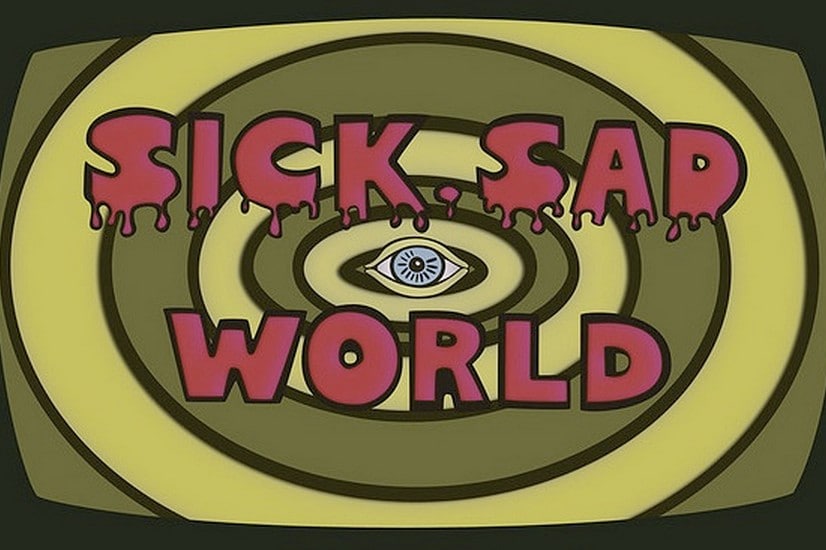
Daria’s teenage contempt for commercial manipulation would seem almost quaint in an age when virtually every human interaction can be monetized, tracked, analyzed, and repackaged into an advertising opportunity. Remember Sick, Sad World, the sensationalistic television program Daria and Jane watched for entertainment? Well, congratulations: we now live inside it. Except instead of watching an amusing television segment about a woman who claims to be romantically involved with her refrigerator, we’re subjected to an endless stream of equally ridiculous stories, delivered directly into our pockets, updated every five seconds, and accompanied by thousands of strangers threatening to murder each other over the correct interpretation of an animated children’s movie. The satirical premise has become the operating system. And it gets worse. The comfortable expectations of American suburban life that underpinned Daria’s adolescence have become increasingly difficult for subsequent generations to attain. Housing has become prohibitively expensive in many parts of the country, higher education can saddle young adults with enormous debt, and the old promise that hard work and a college degree would provide a stable middle-class existence has become far less convincing.
Meanwhile, American political and cultural life seems trapped in a state of perpetual hysteria, with every disagreement transformed into an existential battle and every minor cultural controversy elevated into an emergency requiring the immediate attention of the entire nation. Daria would be absolutely insufferable on social media. Assuming, of course, that she bothered using it. I suspect she would have abandoned the whole enterprise sometime around 2014, after discovering that people she knew from high school were enthusiastically sharing conspiracy theories, motivational business advice, and photographs of their lunches as though these constituted meaningful contributions to Western civilization. Jane, meanwhile, would probably be trying to make a living as an artist in a world where algorithms determine cultural visibility, artificial intelligence can produce an endless supply of technically competent imagery, and the people who actually create things are increasingly expected to provide their work for free in exchange for the magnificent privilege of exposure.
Quinn would almost certainly have become some sort of lifestyle influencer, although one suspects she’d have a nervous breakdown if forced to confront the fact that the Fashion Club’s elaborate social hierarchy has been replaced by a global competition for attention in which every woman on Earth is simultaneously a participant, consumer, and product. Kevin would probably have a podcast. And that’s where I’d have to turn the fucking television off. Because the central tragedy of revisiting Daria in contemporary America is that her cynicism would no longer be particularly remarkable. It would be the default setting. The teenage Daria was an outsider because she looked at a fundamentally optimistic society and questioned its assumptions. The middle-aged Daria would be surrounded by millions of equally disillusioned people who have watched many of those assumptions collapse, and who now express their disappointment in a permanent, screaming chorus of outrage, resentment, and despair.
Her wit wouldn’t be a rebellion against the prevailing culture. It would simply be another contribution to it. That would be a more miserable fate for Daria Morgendorffer than anything she endured at Lawndale High.
The Last Laugh
For all its disaffected humor and relentless mockery of American suburban life, Daria is ultimately a remarkably optimistic show. Which, considering its protagonist regards optimism as something of a communicable disease, might seem an odd conclusion to reach. But consider where the series leaves her. Daria graduates from high school with a genuine friend in Jane, a family that loves her despite their differences, and a future that remains largely unwritten. In Is It College Yet?, college isn’t presented as the doorway to a terrifying economic and cultural wilderness. It’s an opportunity to escape Lawndale, meet people who might actually appreciate her, and become something more than the smartest girl in a room full of idiots. She doesn’t have everything figured out. But she doesn’t have to. Here’s the thing about cynicism: it’s easy to be cynical when times are good. Amusing, even. When the institutions around you are stable, when your family is comfortable, and when you have reasonable expectations that tomorrow will be better than today, being the person who points out how stupid everything is can be a delightful pastime. The world provides the safety net; you provide the sarcasm.
During hard times, however, cynicism loses much of its charm. When people are struggling to pay their bills, wondering what sort of future their children might inherit, or watching the institutions they once trusted deteriorate before their eyes, they don’t particularly need someone in the corner explaining that everything is terrible. They know. They’re living it. Under those circumstances, people need something else: compassion, solidarity, encouragement, and some reason to believe the whole miserable enterprise is still worth the effort. Cynicism can identify a problem, certainly, but it cannot necessarily solve one. And an endless talent for recognizing the worst in everything is a pretty lousy substitute for the ability to find something worth saving. This is the dilemma any serious revival of Daria would have to confront. The very quality that made her such an entertaining and sympathetic teenager in the 1990s could become an enormous liability in the 21st century. Her independence could curdle into isolation; her skepticism into an inability to trust; her refusal to tolerate fools into an exhausting contempt for humanity itself.
The smartest girl in Lawndale might discover that being right about everybody’s shortcomings doesn’t help her survive a world that’s genuinely falling short. So what happens to Daria in middle age? Either she changes, or the world breaks her. Perhaps she learns that intelligence without kindness is merely a more sophisticated way of being an asshole. Perhaps she discovers that optimism isn’t necessarily stupidity, but sometimes the deliberate—and difficult—decision to believe that things can improve. Perhaps she finally understands that caring about the world is considerably harder than mocking it. That could make for an extraordinary television series. It would also require the writers to do something that might strike longtime fans as a betrayal: allow Daria Morgendorffer to become, in some meaningful sense, an optimist. Because an adult Daria who remains exactly as she was at sixteen wouldn’t be a triumph of character consistency. She’d be a tragedy.
And there’s a deeper irony here. Daria spent five seasons regarding herself as an outsider who saw through the illusions of American society. Yet her ability to adopt that perspective depended upon the very society she ridiculed. She could afford to reject its optimism because she was a beneficiary of its prosperity. She could mock its conventions because she was confident there would be a place for her beyond them. In short, Daria wasn’t standing outside the culture at all. She was a product of it. She was a cynical teenager who could only have existed, at least in that particular form, in the 1990s. Which is why I’m not particularly interested in seeing a revival where Daria struggles with mortgage payments, the digital outrage economy, and a parade of former classmates selling fraudulent investment advice on the internet. I certainly don’t want to see Kevin Thompson elected to Congress, a proposition that now seems less like a joke than a perfectly viable career trajectory.
I’d rather leave her where the original series left her: on the threshold of adulthood, armed with a sharp intellect, a wonderfully dry sense of humor, and the faint but unmistakable possibility that the future might be worth looking forward to. Daria remains Great TV not simply because it was funny, intelligent, and wonderfully observant, but because it captured a fleeting moment in American cultural history when teenagers could regard the present with contempt without necessarily regarding the future with dread. The great irony of Daria is that the smartest girl in Lawndale never quite understood how fortunate she was to live there. The world was stupid, certainly. But back then, it was still possible to believe that it might get better.


Leave a Reply